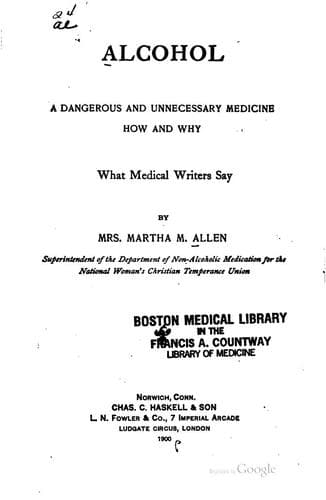
Alcohol: A Dangerous and Unnecessary Medicine, How and Why: What Medical Writers SayAllen, Martha Meir
Science
Alcohol: A Dangerous and Unnecessary Medicine, How and Why: What Medical Writers Say
Allen, Martha Meir
Alcohol -- Physiological effect; Temperance
"Permit me to add that while there may be an honest difference
of opinion regarding the efficacy of legislative enactments in
overcoming or restraining the drink habit, there should be
little doubt that a whole-hearted, persistent,
precept-and-example effort of the medical profession exerted as
individuals on their patients and the families of their
patients, and as associations on the community at large, would
do immeasurable good.
"And the newspapers might aid materially in this beneficent work
if, while they continue to spread before our households every
day the details of the brawls and fights of drunken men and the
horrible murders which they commit, they would discontinue
advertising, without warning or dissent, side by side with the
atrocities, the 'innocuous beers,' the pure malt whiskies, the
genuine brandies, guaranteed to prevent and cure all manner of
diseases."
The following testimony from an English physician is significant:--
"Although I know beforehand that their united testimony must be
in favor of the practice of total abstinence from all
intoxicating drinks, being most conducive to health and
longevity of their patients, but very inimical to the pocket
interests of themselves, my own experience is, that my teetotal
patients are seldom ill, and that they get well very soon again,
if they are attacked by disease. A higher principle than that of
gain must influence a medical man's mind, or he will never
advocate the doctrine of total abstinence."--J. J. RITCHIE, M.
R. C. S., Leek.
"One of the most dangerous phases of the use of alcohol is the
production of a feeling of well being in weakly, dyspeptic,
irritable, nervous or anaemic patients. In consequence of the
temporary relief so obtained, the patient develops a craving for
alcohol, which in many cases can end only in one way, and, as I
felt compelled to tell an assembly of ladies a short time ago,
the very symptoms for the alleviation of which alcohol is
usually taken are those, the presence of which renders it
exceedingly desirable that alcohol should not be taken."--DR. G.
SIMS WOODHEAD, of London.
In an address upon the London Temperance Hospital delivered shortly
before his death, Sir B. W. Richardson gave a brief review of the
influences which led him to abandon the medical use of alcohol. The
following is taken from that address as reported in the _Medical
Pioneer_:--
Public-domain text, read in full here on John Shaqi.
Reviews
Reviews
No reviews yet
Be the first to share your thoughts on this work.
Elsewhere in the archive
Join the Discussion
Join the discussion
Sign in to leave a comment or review.
Sign InorCreate an account