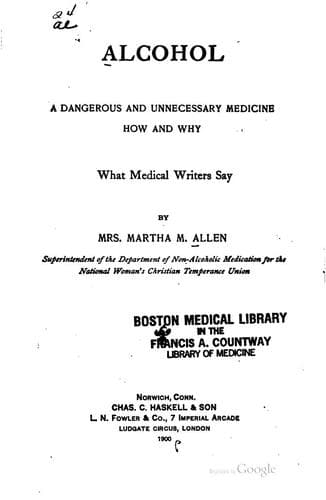
Alcohol: A Dangerous and Unnecessary Medicine, How and Why: What Medical Writers SayAllen, Martha Meir
Science
Alcohol: A Dangerous and Unnecessary Medicine, How and Why: What Medical Writers Say
Allen, Martha Meir
Alcohol -- Physiological effect; Temperance
In the year 1900 Prof. Taav Laitinen, of the University of Helsingfors,
Finland, published an account of experiments made upon 342
animals--dogs, rabbits, guinea pigs, fowls and pigeons--to determine the
effects of alcohol upon the resistance of the body to infectious
diseases. He used as infecting agents, anthrax bacilli, tubercle
bacilli, and diphtheria bacilli. The doses of alcohol given varied with
the animal. For his "small dose" experiments he used the quantity of
alcohol given as a food or as a medicine, or both, in a neighboring
sanitorium. The alcohol employed was, as a rule, a 25 per cent. solution
of ethyl alcohol in water. It was given either by esophageal catheter,
or by dropping it into the mouth from a pipette. It was administered in
several ways, and for varying times; sometimes in single large doses, at
others in gradually increasing doses for months at a time, in order to
produce here an acute, and there a chronic poisoning; in fact, he
produced the conditions consequent upon steady, moderate drinking.
His first conclusion from these experiments, most carefully carried out,
is that alcohol, however given, induces in the animal body a markedly
increased susceptibility to infectious diseases; and he maintains that
his experiments indicate that the use of alcohol, at least in the
treatment of anthrax, tuberculosis, and diphtheria, is not only useless
but probably injurious. From a number of other experiments carried out
with scrupulous care he comes to the same conclusion as Abbott, Welch,
and others that the predisposing to disease of alcohol must be explained
by its action in producing abnormal conditions--pathological changes in
the alimentary canal, liver, kidneys, heart, and nervous system. He
found that the alkalinity of the blood was slightly diminished, and the
number of leucocytes somewhat decreased. He also draws attention to the
fact that his experiments prove that pregnant animals and their
offspring are markedly affected by the continued use of small doses of
alcohol. He shows, too, that the temporary lowering of the body
temperature by alcohol produces the most favorable condition for the
invasion of disease germs.
Since the publication of these experiments, and of others similar to
them, the use of alcohol in diphtheria and tuberculosis has very largely
ceased. Boards of health and charity organizations unite in warning
against indulgence in alcoholic drinks as conducive to tuberculosis.
At the International Congress on Alcoholism, held in London in July,
1909, Professor Laitinen delivered two lectures. The first was upon "The
Influence of Alcohol on Immunity." The following is taken from this
lecture:--
Public-domain text, read in full here on John Shaqi.
Reviews
Reviews
No reviews yet
Be the first to share your thoughts on this work.
Elsewhere in the archive
Join the Discussion
Join the discussion
Sign in to leave a comment or review.
Sign InorCreate an account