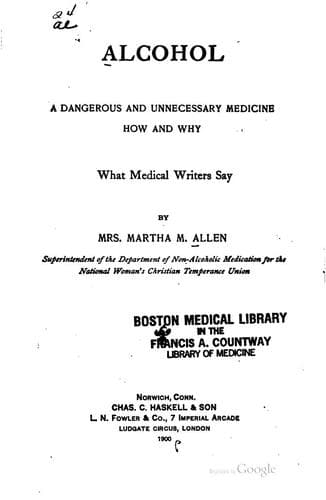
Alcohol: A Dangerous and Unnecessary Medicine, How and Why: What Medical Writers SayAllen, Martha Meir
Science
Alcohol: A Dangerous and Unnecessary Medicine, How and Why: What Medical Writers Say
Allen, Martha Meir
Alcohol -- Physiological effect; Temperance
"Modern researches have done much to explain the extent and
nature of the protective powers by which the organism endeavors
to defend itself against the attacks of all kinds of injurious
agencies, and especially against invasion by the germs of
infective diseases. It is now a well-established fact that
alcohol weakens the normal resisting power of the body against
the above-named disease-producing influences. In the hope of
contributing something to the explanation of the way in which
alcohol weakens the organism, I have made a number of
experiments bearing upon the question of the influence of
alcohol on immunity.
"Early in this century careful experiments went to show that
alcohol certainly had some influence upon immunity. Two
Americans, Abbott and Bergey, were the first to discover that
this agent produces a diminution of the haemolytic complement in
the blood-serum of certain animals which were tested. They
showed also that the formation of specific haemolytic receptors
(immune bodies) may be retarded by the action of alcohol.
"The extent of the evil effects upon the human body resulting
from the consumption of alcoholic liquors is as yet far from
being fully known, and stands in need of scientific
verification. Many other injurious influences such as unsanitary
dwellings, bad feeding, excessive toil, and toxic agents like
nicotine, etc., may produce somewhat similar morbid effects. It
is therefore necessary, in the scientific study of the question,
to take these possibilities into consideration. In my
investigations, the results of which I am now to lay before you,
I have endeavored to select as subjects for my experiments both
abstainers from alcohol, and those who indulge more or less in
its use, in such a way that their conditions of life and their
habits in other respects should be as nearly as possible the
same. All persons, for instance, suffering from any acute or
chronic disease were rejected, and very few of the persons
selected were smokers. The subject of this research has been
human blood, and especially its two principal components,
namely, red blood-corpuscles and blood-serum, both of which up
to the present time have been very little studied in relation to
the question under discussion. I have gone into these matters
chiefly because the modern theoretical study of immunity during
the last few years has, in general, attracted greater attention
to the blood, and shown the important role which the different
parts, properties, and capacities of the blood play in defending
the organism against internal and external injurious agencies.
Further, the subtle methods employed in the study of immunity
(such as organic reactions, and reactions between greatly
attenuated organic liquids) would also seem to be available for
Public-domain text, read in full here on John Shaqi.
Reviews
Reviews
No reviews yet
Be the first to share your thoughts on this work.
Elsewhere in the archive
Join the Discussion
Join the discussion
Sign in to leave a comment or review.
Sign InorCreate an account