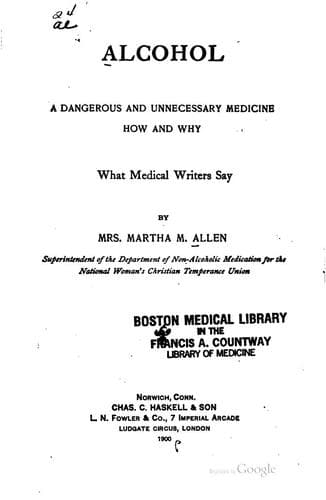
Alcohol: A Dangerous and Unnecessary Medicine, How and Why: What Medical Writers SayAllen, Martha Meir
Science
Alcohol: A Dangerous and Unnecessary Medicine, How and Why: What Medical Writers Say
Allen, Martha Meir
Alcohol -- Physiological effect; Temperance
"1. The normal resistance of human red blood-corpuscles appears
to be somewhat diminished against a heterogeneous normal serum
or an immune serum by the consumption of alcohol, provided that
tolerably large equal, or nearly equal, numbers of drinkers and
abstainers of both sexes be examined, and the average of
resistance be taken on both sides: this last-named precaution
being necessary because the resistance of red blood-corpuscles
from different human beings varies largely. The difference is
often greater when using weaker solutions than when using
stronger dilutions of lysin.
"2. These experiments have shown the normal haemolytic power of
human blood-serum to be less in the case of alcohol-drinkers
than in that of abstainers.
"3. The precipitating reaction between a solution of 1 per cent.
human blood-serum and different dilutions of immune serum was
greater in the case of drinkers than in that of abstainers.
"4. These experiments have also shown that the bactericidal
power of blood-serum against typhoid bacteria was less in the
case of drinkers than in that of abstainers.
"It seems clear, therefore, that alcohol, even in comparatively
small doses, exercises a prejudicial effect on the protective
mechanism of the human body."
The lecturer made his points clear by a carefully prepared series of
charts. At its close Sir Victor Horsley, Professor Sims Woodhead, A.
Pearce Gould, and several other distinguished physicians spoke in high
terms of the painstaking care exhibited in the experiments.
Professor Laitinen's second lecture was upon "The Influence of Alcohol
Upon Human Offspring." He sent out 15,000 circulars to his countrymen,
asking many questions relative to themselves and their infant children,
and received 5,845 replies relative to 20,008 children. He also studied
personally a large number of drinking and abstaining families. From
these studies he shows by careful tables that the drinking of alcohol by
parents, even in small quantities, has an injurious influence upon human
offspring. His studies in former years showed the same unfavorable
influence upon the offspring of animals. One of his tables gives
percentages of deaths of children in the homes of abstaining parents,
moderate drinkers, and harder drinkers. Children of abstainers dying in
the first year, 13.45 per cent.; of moderates, 23.17 per cent.; of
harder drinkers, 32.02 per cent. Other tables show that abstainers'
children gain in weight more steadily in the first year than drinkers'
children, and have their teeth earlier, as a rule.
At the International Medical Congress of 1909, held in Budapest,
Professor Laitinen lectured again upon his researches, and summarized
his conclusions thus:--
Public-domain text, read in full here on John Shaqi.
Reviews
Reviews
No reviews yet
Be the first to share your thoughts on this work.
Elsewhere in the archive
Join the Discussion
Join the discussion
Sign in to leave a comment or review.
Sign InorCreate an account