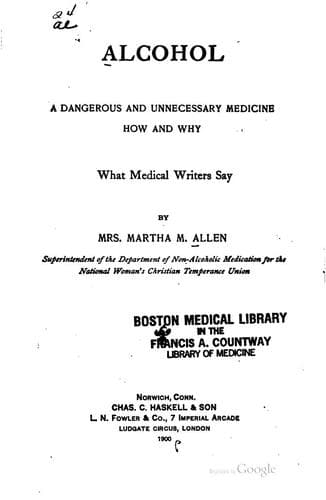
Alcohol: A Dangerous and Unnecessary Medicine, How and Why: What Medical Writers SayAllen, Martha Meir
Science
Alcohol: A Dangerous and Unnecessary Medicine, How and Why: What Medical Writers Say
Allen, Martha Meir
Alcohol -- Physiological effect; Temperance
"1. The importance of alcohol as an article of food is rendered
very questionable by recent researches. 2. These researches
prove that alcohol diminishes the natural power of the tissues
to resist injury, promotes degeneration, and has a disastrous
effect on future generations. 3. The questions of relation of
alcoholic liquor to crime and of the manufacture and sale of
such beverages deserve the serious consideration of the
legislature. 4. It is the duty of medical men to direct more
attention than formerly to the alcohol question, and by careful
study to decide whether recent researches are justified or not
in regarding alcohol and alcoholic beverages as a poison and one
of the principal causes of degeneration in the human family;
they ought also to consider whether it would not be advisable in
medical practice, and especially in hospitals, either to banish
it altogether or at least to prescribe it with the same care as
other poisonous drugs. In this matter the attitude taken by
medical men as representatives of public hygiene was of quite
exceptional importance."
Metchnikoff, the illustrious Russian scientist, who has for some years
been connected with the Pasteur Institute in Paris, was the discoverer
of the work assigned by nature to the white corpuscles of the blood.
These blood-cells are the "guardian-cells" of the body, and their duty
is to destroy disease germs which may gain an entrance. They actually
devour disease germs. Metchnikoff has been studying the effect of
alcohol upon these protective cells, and he asserts that alcohol, even
in small doses, has a harmful action on these agents of defence against
disease. Alcohol seems to paralyze them more or less so that they are
unable to do their full duty in destroying the infective microbes. Thus
disease germs can multiply more rapidly when alcohol is in the blood. In
his book called "The New Hygiene," Metchnikoff suggests that the
administration of alcoholic liquors in infectious disease appears to be
attended with danger to the patient.
The researches of Kraepelin, Ach, Aschaffenberg and other German
scientists have become so well known through the articles by Henry Smith
Williams in _McClure's Magazine_ that only brief reference need be made
to them here. Kraepelin used very small doses of alcohol for some of his
experiments. He found that after 1/4 to 1/2 ounce of alcohol had been
taken the time occupied in making response to a signal was slightly
shortened, but in a few minutes, in most cases, this quickening action
passed and a slowing process began, and continued until the body was
free from the influence of the alcohol, which was sometimes four or five
hours.
Public-domain text, read in full here on John Shaqi.
Reviews
Reviews
No reviews yet
Be the first to share your thoughts on this work.
Elsewhere in the archive
Join the Discussion
Join the discussion
Sign in to leave a comment or review.
Sign InorCreate an account