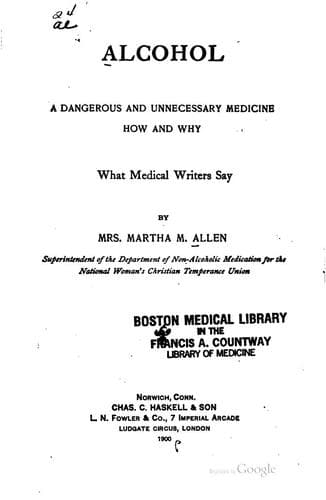
Alcohol: A Dangerous and Unnecessary Medicine, How and Why: What Medical Writers SayAllen, Martha Meir
Science
Alcohol: A Dangerous and Unnecessary Medicine, How and Why: What Medical Writers Say
Allen, Martha Meir
Alcohol -- Physiological effect; Temperance
"It is, I think, quite plain that while alcohol in moderate
amounts can be burned in the body, thus serving as food in the
sense that it may be a source of energy, it is quite misleading
to attempt a classification or even comparison of alcohol with
carbohydrates and fats, since, unlike the latter, alcohol has a
most disturbing effect upon the metabolism or oxidation of the
purin compounds of our daily food. Alcohol, therefore, presents
a dangerous side wholly wanting in carbohydrates and fats. The
latter are simply burned up to carbonic acid and water, or are
transformed into glycogen and fat, but alcohol, though more
easily oxidizable, is at all times liable to obstruct, in some
measure at least, the oxidative processes of the liver, and
probably of other tissues also, thereby throwing into the
circulation bodies such as uric acid, which are inimical to
health; a fact which at once tends to draw a distinct line of
demarcation between alcohol and the two non-nitrogeneous
foods--fat and carbohydrate."
Dr. S. P. Beebe, now of the Cornell Medical College Laboratory, New York
City, has made some very valuable experiments with alcohol. It is well
known that impairment of the functions of certain organs results in the
appearance in the urine of nitrogeneous compounds which do not normally
occur there. In certain diseases of the liver the same quantity of
nitrogen may be excreted as in health, but a portion of it is in the
form of acids never found in the urine during health. Dr. Beebe, with
this knowledge in mind, sought to discover the effects of alcohol upon
the excretion of uric acid in man. Most of the experiments were made on
the same person, a young man in good health, of regular habits,
unaccustomed to the use of alcohol in any form. Absolute alcohol,
diluted with water, whisky, ale, and port wine were used at different
times. Dr. Beebe reported his experiments in the _American Journal of
Physiology_, vol. 12, No. 1. His conclusions are given as follows:--
"After a consideration of these experiments, it hardly seems
possible to doubt that alcohol, even in what is considered by
the most conservative as a moderate amount, causes an increase
in the excretion of uric acid, and this effect is seen almost
immediately after taking the alcohol. The following points
indicate that the effect is due to a toxic effect on the liver,
thereby interfering with the oxidation of the uric acid derived
from its precursors in the food: Alcohol taken without food
causes no increase. The maximum increase occurs at the same time
after a meal as it does when purin food but no alcohol is taken.
Alcohol is rapidly absorbed and passes at once to the liver, the
organ which has most to do with the metabolism of proteid
cleavage products.
Public-domain text, read in full here on John Shaqi.
Reviews
Reviews
No reviews yet
Be the first to share your thoughts on this work.
Elsewhere in the archive
Join the Discussion
Join the discussion
Sign in to leave a comment or review.
Sign InorCreate an account