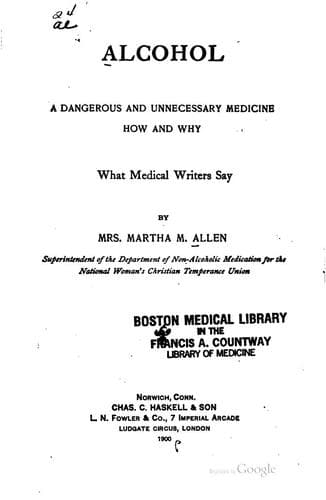
Alcohol: A Dangerous and Unnecessary Medicine, How and Why: What Medical Writers SayAllen, Martha Meir
Science
Alcohol: A Dangerous and Unnecessary Medicine, How and Why: What Medical Writers Say
Allen, Martha Meir
Alcohol -- Physiological effect; Temperance
"These experiments with alcohol and acetonitrile are of interest
in another connection. The greatest advance in recent years in
our knowledge of the physiological action of alcohol has been
the clear demonstration that alcohol is oxidized in the body,
and may replace fats and carbohydrates and to a certain extent,
the proteids of an ordinary diet. So clear has been this
demonstration that the view that alcohol, in moderate amounts,
should be regarded as a food is almost universally accepted by
physiologists, and the drift of opinion is certainly toward the
view that it is in all respects strictly analogous to sugar and
fats, provided always that the amount used does not exceed that
easily oxidized by the body. Under these premises it would be
expected that alcohol in a diet would have the same effect upon
an animal's susceptibility to acetonitrile as has dextrose, for
example. This is by no means the case, however; on the contrary,
the action of these substances in this regard is entirely
different. Mice fed upon oats soaked in a solution of dextrose
or upon cakes containing considerable dextrose, or upon rice,
show a very distinct increase in their resistance to
acetonitrile; such mice may recover from two or three times the
dose fatal to controls. (Controls are the animals fed in the
ordinary way without alcohol or in this case dextrose.--Ed.)
While these facts are not sufficient to justify the conclusion
that in many cases alcohol has not a true food value, yet they
are sufficient to indicate caution in applying, without further
consideration, the brilliant and very exact results on the
proteid sparing power of alcohol to practical dietaries."
Various other experiments were made, but there is not room here for a
record of them.
In the summary Dr. Hunt says:--
"It is believed that these experiments afford clear experimental
evidence for the view that extremely moderate amounts of alcohol
may cause distinct changes in certain physiological functions,
and that these changes may, under certain circumstances, be
injurious to the body. The results also afford further evidence
that in some respects the action of alcohol as a food is
different from that of carbohydrates, and finally that in all
probability certain physiological processes in 'moderate
drinkers' are distinctly different from those in abstainers."
Professor Chittenden, of Yale University, has made extensive researches
upon alcohol and digestion. A full report of these may be found in the
"Physiological Aspects of the Liquor Problem." In the _Medical News_,
vol. 86, page 721, Professor Chittenden says of the theory that alcohol
is a food similar to sugar and fats:--
Public-domain text, read in full here on John Shaqi.
Reviews
Reviews
No reviews yet
Be the first to share your thoughts on this work.
Elsewhere in the archive
Join the Discussion
Join the discussion
Sign in to leave a comment or review.
Sign InorCreate an account