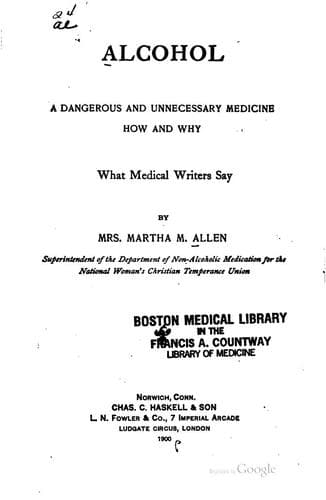
Alcohol: A Dangerous and Unnecessary Medicine, How and Why: What Medical Writers SayAllen, Martha Meir
Science
Alcohol: A Dangerous and Unnecessary Medicine, How and Why: What Medical Writers Say
Allen, Martha Meir
Alcohol -- Physiological effect; Temperance
"The fact that alcohol is oxidized in the body has been
generally misunderstood. The first impression naturally was:
'Foods are Oxidized; Alcohol is Oxidized; therefore alcohol is
a food.' But many difficulties appeared. A real food promotes
muscular, glandular and nerve activity, and its oxidation
maintains body temperature. But alcohol disturbs muscular,
glandular, and nervous activity, and its oxidation does not
maintain body temperature. When one eats a real food it is
assimilated largely by muscle tissue and is oxidized for the
purpose of liberating the life energy. When one ingests alcohol
it is carried by the blood to the tissues, mostly to the liver,
where it is oxidized, as any toxine would be, for the purpose of
making it harmless. Its oxidation liberates heat energy but this
energy cannot be utilized by the body even for the maintenance
of body temperature. If a food is defined as a substance which,
taken into the body, is assimilated and used either to build or
repair body structure, or to be oxidized in the tissues to
liberate the energy used by the tissue in its normal activity,
then alcohol is not a real food.
"But, if alcohol is not a real food, what is the significance of
its oxidation? It has been long known that the liver produces
oxidases and that it is the site of active oxidation of
mid-products of katabolism of toxins and of other toxic
substances. Alcohol, usually formed as an excretion of the yeast
plant, is also found as a mid-product of tissue katabolism. On a
priori grounds we should expect alcohol to be oxidized in the
liver along with leucin, tyrosin, uric acid, xanthin bodies, and
various amido bodies. There have recently appeared two most
important papers based upon extended researches upon man and
lower animals. These researches practically clear up this knotty
question."
Dr. Hall then reviews the work of Dr. Reid Hunt and Dr. S. P. Beebe, and
continues:--
"The value of this work can hardly be over-estimated. In the
first place the rapid oxidation of the alcohol in the liver is
explained. _Alcohol itself being one of the toxic substances
which reach the liver from the alimentary canal is at once
attacked by the liver, and if the oncoming tide of alcohol is
not too great it will practically all be oxidized._
Public-domain text, read in full here on John Shaqi.
Reviews
Reviews
No reviews yet
Be the first to share your thoughts on this work.
Elsewhere in the archive
Join the Discussion
Join the discussion
Sign in to leave a comment or review.
Sign InorCreate an account