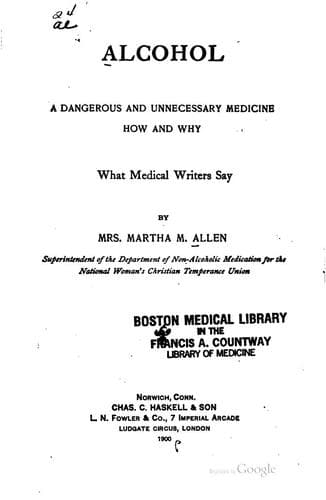
Alcohol: A Dangerous and Unnecessary Medicine, How and Why: What Medical Writers SayAllen, Martha Meir
Science
Alcohol: A Dangerous and Unnecessary Medicine, How and Why: What Medical Writers Say
Allen, Martha Meir
Alcohol -- Physiological effect; Temperance
"But the liver oxidation of other toxic substances is impaired
in the meantime so that they get past the liver to the tissues,
where they may do injury. Some of these toxins are excreted
unoxidized by the kidneys. There are three ways of accounting
for this condition: (1.) The oxidation capacity of the liver is
limited. The physiological limit of alcohol ingestion is that
amount which taxes the oxidation capacity of the liver to its
limit. When thus taxed all other toxic substances including uric
acid and the xanthin bodies pass through the liver unoxidized to
appear in the urine. (2.) The presence of alcohol in the blood,
through its toxic action upon the liver cells, impairs the
hepatic oxidation capacity and thus permits toxic substances to
pass unoxidized. (3.) A combination of these conditions may
represent the real situation. It is hardly conceivable that the
relation of alcohol to the liver activity is not covered in the
hypotheses above formulated.
"We may therefore accept it as practically demonstrated by the
researches of Beebe, Hunt, and others that the oxidation of
alcohol in the liver is simply one of the defensive activities
of that organ, _i. e._, it is a protective oxidation and belongs
strictly in the same category with the oxidation of uric acid,
xanthin bodies, leucin, tyrosins, and the amido acids.
"The next question which arises is, why does the liver select
alcohol first and oxidize that substance to the exclusion of
other toxic substances up to the oxidation capacity? The answer
is probably to be found in the chemical composition of alcohol.
"It oxidizes very easily, much more so than any of the other
toxic substances which gain access to the liver. Its early
oxidation may be due to this fact alone, or in part to an actual
selection on the part of the liver. Another question of
importance: Is the energy liberated in the oxidation of alcohol
in the liver available for the use of the muscles, nervous
system, or glands?
"If this question is answered affirmatively, then alcohol is a
food. If negatively then alcohol is not a food. Let us reason
together. All body oxidations may be classified in two groups:
(1.) _Active oxidations_ which take place in the active
tissues--muscles, nervous system, or glands--and take place
incident to action. It is under the perfect control of the
nervous system and is proportional to normal activity. (2.)
_Protective oxidations_ which take place in the liver. This
class of oxidation processes is wholly independent of the usual
tissue activity and is proportional to the ingestion of toxic
substances and quite independent of muscle action, brain action,
or gland action, other than liver action.
Public-domain text, read in full here on John Shaqi.
Reviews
Reviews
No reviews yet
Be the first to share your thoughts on this work.
Elsewhere in the archive
Join the Discussion
Join the discussion
Sign in to leave a comment or review.
Sign InorCreate an account