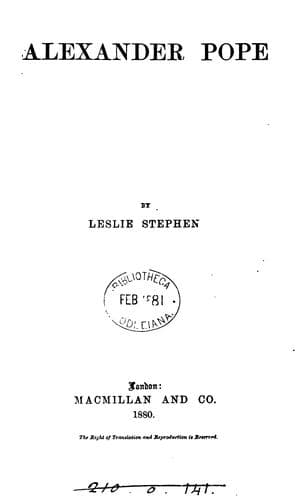
Poets, English -- 18th century -- Biography; Pope, Alexander, 1688-1744
Pope now applied to their common friend Lord Orrery. Orrery was the dull
member of a family eminent for its talents. His father had left a
valuable library to Christ Church, ostensibly because the son was not
capable of profiting by books, though a less creditable reason has been
assigned.[17] The son, eager to wipe off the imputation, specially
affected the society of wits, and was elaborately polite both to Swift
and Pope. Pope now got Orrery to intercede with Swift, urging that the
letters were no longer safe in the custody of a failing old man. Orrery
succeeded, and brought the letters in a sealed packet to Pope in the
summer of 1737. Swift, it must be added, had an impression that there
was a gap of six years in the collection; he became confused as to what
had or had not been sent, and had a vague belief in a "great collection"
of letters "placed in some very safe hand."[18] Pope, being thus in
possession of the whole correspondence, proceeded to perform a
manoeuvre resembling those already employed in the case of the Dunciad
and of the P. T. letters. He printed the correspondence clandestinely.
He then sent the printed volume to Swift, accompanied by an anonymous
letter. This letter purported to come from some persons who, from
admiration of Swift's private and public virtues, had resolved to
preserve letters so creditable to him, and had accordingly put them in
type. They suggested that the volume would be suppressed if it fell into
the hands of Bolingbroke and Pope (a most audacious suggestion!), and
intimated that Swift should himself publish it. No other copy, they
said, was in existence. Poor Swift fell at once into the trap. He
ought, of course, to have consulted Pope or Bolingbroke, and would
probably have done so had his mind been sound. Seeing, however, a volume
already printed, he might naturally suppose that, in spite of the
anonymous assurance, it was already too late to stop the publication. At
any rate, he at once sent it to his publisher, Faulkner, and desired him
to bring it out at once. Swift was in that most melancholy state in
which a man's friends perceive him to be incompetent to manage his
affairs, and are yet not able to use actual restraint. Mrs. Whiteway,
the sensible and affectionate cousin who took care of him at this time,
did her best to protest against the publication, but in vain. Swift
insisted. So far Pope's device was successful. The printed letters had
been placed in the hands of his bookseller by Swift himself, and
publication was apparently secured. But Pope had still the same problem
as in the previous case. Though he had talked of erecting a monument to
Swift and himself, he was anxious that the monument should apparently be
erected by some one else. His vanity could only be satisfied by the
appearance that the publication was forced upon him. He had, therefore,
to dissociate himself from the publication by some protest at once
emphatic and ineffectual; and, consequently, to explain the means by
Public-domain text, read in full here on John Shaqi.
Reviews
Reviews
No reviews yet
Be the first to share your thoughts on this work.
Elsewhere in the archive
Join the Discussion
Join the discussion
Sign in to leave a comment or review.
Sign InorCreate an account