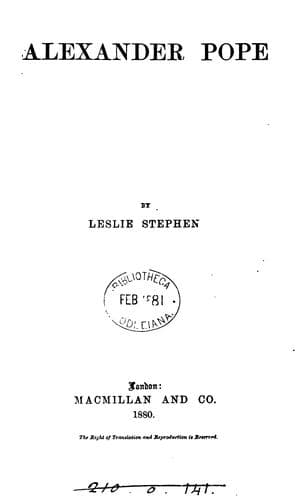
Poets, English -- 18th century -- Biography; Pope, Alexander, 1688-1744
which the letters had been surreptitiously obtained.
The first aim was unexpectedly difficult. Faulkner turned out to be an
honest bookseller. Instead of sharing Curll's rapacity, he consented, at
Mrs. Whiteway's request, to wait until Pope had an opportunity of
expressing his wishes. Pope, if he consented, could no longer complain;
if he dissented, Faulkner would suppress the letters. In this dilemma,
Pope first wrote to Faulkner to refuse permission, and at the same time
took care that his letter should be delayed for a month. He hoped that
Faulkner would lose patience, and publish. But Faulkner, with provoking
civility, stopped the press as soon as he heard of Pope's objection.
Pope hereupon discovered that the letters were certain to be published,
as they were already printed, and doubtless by some mysterious
"confederacy of people" in London. All he could wish was to revise them
before appearance. Meanwhile he begged Lord Orrery to inspect the book,
and say what he thought of it. "Guess in what a situation I must be,"
exclaimed this sincere and modest person, "not to be able to see what
all the world is to read as mine!" Orrery was quite as provoking as
Faulkner. He got the book from Faulkner, read it, and instead of begging
Pope not to deprive the world of so delightful a treat, said with dull
integrity, that he thought the collection "unworthy to be published."
Orrery, however, was innocent enough to accept Pope's suggestion, that
letters which had once got into such hands would certainly come out
sooner or later. After some more haggling, Pope ultimately decided to
take this ground. He would, he said, have nothing to do with the
letters; they would come out in any case; their appearance would please
the Dean, and he (Pope) would stand clear of all responsibility. He
tried, indeed, to get Faulkner to prefix a statement tending to fix the
whole transaction upon Swift; but the bookseller declined, and the
letters ultimately came out with a simple statement that they were a
reprint.
Public-domain text, read in full here on John Shaqi.
Reviews
Reviews
No reviews yet
Be the first to share your thoughts on this work.
Elsewhere in the archive
Join the Discussion
Join the discussion
Sign in to leave a comment or review.
Sign InorCreate an account