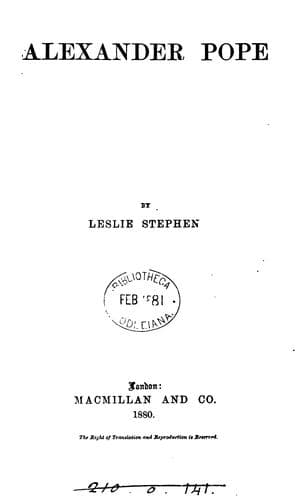
Poets, English -- 18th century -- Biography; Pope, Alexander, 1688-1744
Bolingbroke received a pardon in 1723, and returned to England, crossing
Atterbury, who had just been convicted of treasonable practices. In 1725
Bolingbroke settled at Dawley, near Uxbridge, and for the next ten years
he was alternately amusing himself in playing the retired philosopher,
and endeavouring, with more serious purpose, to animate the opposition
to Walpole. Pope, who was his frequent guest, sympathized with his
schemes, and was completely dazzled by his eminence. He spoke of him
with bated breath, as a being almost superior to humanity. "It looks,"
said Pope once, "as if that great man had been placed here by mistake.
When the comet appeared a month or two ago," he added, "I sometimes
fancied that it might be come to carry him home, as a coach comes to
one's door for other visitors." Of all the graceful compliments in
Pope's poetry, none are more ardent or more obviously sincere than those
addressed to this "guide, philosopher, and friend." He delighted to bask
in the sunshine of the great man's presence. Writing to Swift in 1728,
he (Pope) says that he is holding the pen "for my Lord Bolingbroke," who
is reading your letter between two haycocks, with his attention
occasionally distracted by a threatening shower. Bolingbroke is acting
the temperate recluse, having nothing for dinner but mutton-broth, beans
and bacon, and a barndoor fowl. Whilst his lordship is running after a
cart, Pope snatches a moment to tell how the day before this noble
farmer had engaged a painter for 200_l._ to give the correct
agricultural air to his country hall by ornamenting it with trophies of
spades, rakes, and prongs. Pope saw that the zeal for retirement was not
free from affectation, but he sat at the teacher's feet with profound
belief in the value of the lessons which flowed from his lips.
The connexion was to bear remarkable fruit. Under the direction of
Bolingbroke, Pope resolved to compose a great philosophical poem. "Does
Pope talk to you," says Bolingbroke to Swift in 1731, "of the noble work
which, at my instigation, he has begun in such a manner that he must be
convinced by this time I judged better of his talents than he did?" And
Bolingbroke proceeds to describe the Essay on Man, of which it seems
that three (out of four) epistles were now finished. The first of these
epistles appeared in 1733. Pope, being apparently nervous on his first
appearance as a philosopher, withheld his name. The other parts followed
in the course of 1733 and 1734, and the authorship was soon avowed. The
Essay on Man is Pope's most ambitious performance, and the one by which
he was best known beyond his own country. It has been frequently
translated, it was imitated both in France and Germany, and provoked a
controversy, not like others in Pope's history of the purely personal
kind.
The Essay on Man professes to be a theodicy. Pope, with an echo of the
Miltonic phrase, proposes to
Vindicate the ways of God to man.
Public-domain text, read in full here on John Shaqi.
Reviews
Reviews
No reviews yet
Be the first to share your thoughts on this work.
Elsewhere in the archive
Join the Discussion
Join the discussion
Sign in to leave a comment or review.
Sign InorCreate an account