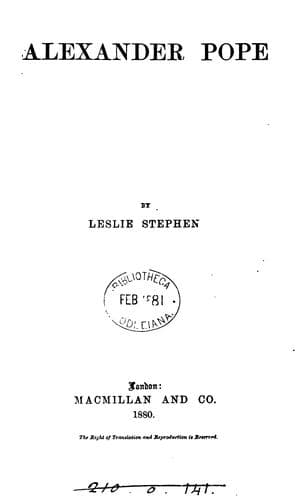
Poets, English -- 18th century -- Biography; Pope, Alexander, 1688-1744
He is thus attempting the greatest task to which poet or philosopher can
devote himself--the exhibition of an organic and harmonious view of the
universe. In a time when men's minds are dominated by a definite
religious creed, the poet may hope to achieve success in such an
undertaking without departing from his legitimate method. His vision
pierces to the world hidden from our senses, and realizes in the
transitory present a scene in the slow development of a divine drama. To
make us share his vision is to give his justification of Providence.
When Milton told the story of the war in heaven and the fall of man, he
gave implicitly his theory of the true relations of man to his Creator,
but the abstract doctrine was clothed in the flesh and blood of a
concrete mythology.
In Pope's day the traditional belief had lost its hold upon men's minds
too completely to be used for imaginative purposes. The story of Adam
and Eve would itself require to be justified or to be rationalized into
thin allegory. Nothing was left possessed of any vitality but a bare
skeleton of abstract theology, dependent upon argument instead of
tradition, and which might use or might dispense with a Christian
phraseology. Its deity was not a historical personage, but the name of a
metaphysical conception. For a revelation was substituted a
demonstration. To vindicate Providence meant no longer to stimulate
imagination by pure and sublime rendering of accepted truths, but to
solve certain philosophical problems, and especially the grand
difficulty of reconciling the existence of evil with divine omnipotence
and benevolence.
Public-domain text, read in full here on John Shaqi.
Reviews
Reviews
No reviews yet
Be the first to share your thoughts on this work.
Elsewhere in the archive
Join the Discussion
Join the discussion
Sign in to leave a comment or review.
Sign InorCreate an account