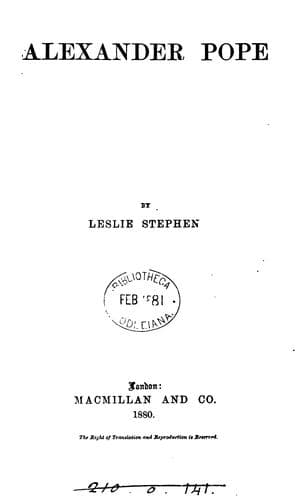
Poets, English -- 18th century -- Biography; Pope, Alexander, 1688-1744
It was strange enough that any poem should arise by such means; but it
would have been miraculous if a poem so constructed had been at once a
demonstration and an exposition of a harmonious philosophical system.
The confession which he made to Warburton will be a sufficient
indication of his qualifications as a student. He says (in 1739) that he
never in his life read a line of Leibnitz, nor knew, till he found it in
a confutation of his Essay, that there was such a term as
pre-established harmony. That is almost as if a modern reconciler of
faith and science were to say that he had never read a line of Mr.
Darwin, or heard of such a phrase as the struggle for existence. It was
to pronounce himself absolutely disqualified to speak as a philosopher.
How, then, could Pope obtain even an appearance of success? The problem
should puzzle no one at the present day. Every smart essayist knows how
to settle the most abstruse metaphysical puzzles after studies limited
to the pages of a monthly magazine; and Pope was much in the state of
mind of such extemporizing philosophers. He had dipped into the books
which everybody read; Locke's Essay, and Shaftesbury's Characteristics,
and Wollaston's Religion of Nature, and Clarke on the Attributes, and
Archbishop King on the Origin of Evil, had probably amused his spare
moments. They were all, we may suppose, in Bolingbroke's library; and if
that passing shower commemorated in Pope's letter drove them back to the
house, Bolingbroke might discourse from the page which happened to be
open, and Pope would try to versify it on the back of an envelope.[20]
Nor must we forget, like some of his commentators, that after all Pope
was an exceedingly clever man. His rapidly perceptive mind was fully
qualified to imbibe the crude versions of philosophic theories which
float upon the surface of ordinary talk, and are not always so inferior
to their prototypes in philosophic qualities, as philosophers would have
us believe. He could by snatches seize with admirable quickness the
general spirit of a doctrine, though unable to sustain himself at a high
intellectual level for any length of time. He was ready with abundance
of poetical illustrations, not, perhaps, very closely adapted to the
logic, but capable of being elaborated into effective passages; and,
finally, Pope had always a certain number of more or less appropriate
commonplaces or renderings into verse of some passages which had struck
him in Pascal, or Rochefoucauld, or Bacon, all of them favourite
authors, and which could be wrought into the structure at a slight cost
of coherence. By such means he could put together a poem, which was
certainly not an organic whole, but which might contain many striking
sayings and passages of great rhetorical effect.
Public-domain text, read in full here on John Shaqi.
Reviews
Reviews
No reviews yet
Be the first to share your thoughts on this work.
Elsewhere in the archive
Join the Discussion
Join the discussion
Sign in to leave a comment or review.
Sign InorCreate an account