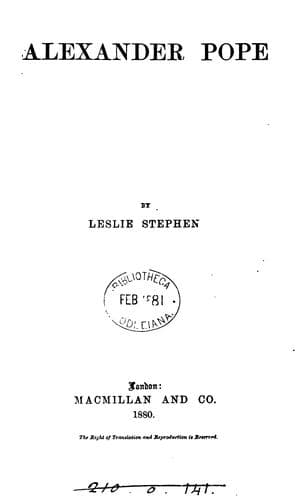
Poets, English -- 18th century -- Biography; Pope, Alexander, 1688-1744
The logical framework was, we may guess, supplied mainly by Bolingbroke.
Bathurst told Warton that Bolingbroke had given Pope the essay in prose,
and that Pope had only turned it into verse; and Mallet--a friend of
both--is said to have seen the very manuscript from which Pope worked.
Johnson, on hearing this from Boswell, remarked that it must be an
overstatement. Pope might have had from Bolingbroke the "philosophical
stamina" of the essay, but he must, at least, have contributed the
"poetical imagery," and have had more independent power than the story
implied. It is, indeed, impossible accurately to fix the relations of
the teacher and his disciple. Pope acknowledged in the strongest
possible terms his dependence upon Bolingbroke, and Bolingbroke claims
with equal distinctness the position of instigator and inspirer. His
more elaborate philosophical works are in the form of letters to Pope,
and profess to be a redaction of the conversations which they had had
together. These were not written till after the Essay on Man; but a
series of fragments appear to represent what he actually set down for
Pope's guidance. They are professedly addressed to Pope. "I write," he
says (fragment 65), "to you and for you, and you would think yourself
little obliged to me if I took the pains of explaining in prose what you
would not think it necessary to explain in verse,"--that is, the
free-will puzzle. The manuscripts seen by Mallet may probably have been
a commonplace book in which Bolingbroke had set down some of these
fragments, by way of instructing Pope, and preparing for his own more
systematic work. No reader of the fragments can, I think, doubt as to
the immediate source of Pope's inspiration. Most of the ideas expressed
were the common property of many contemporary writers, but Pope accepts
the particular modification presented by Bolingbroke.[21] Pope's
manipulation of these materials causes much of the Essay on Man to
resemble (as Mr. Pattison puts it) an exquisite mosaic work. A detailed
examination of his mode of transmutation would be a curious study in the
technical secrets of literary execution. A specimen or two will
sufficiently indicate the general character of Pope's method of
constructing his essay.
The forty-third fragment of Bolingbroke is virtually a prose version of
much of Pope's poetry. A few phrases will exhibit the relation:--
Through worlds unnumber'd though the God be known,
'Tis ours to _trace Him only in our own_.
He who through vast immensity can pierce,
See worlds on worlds _compose one universe_,
Observe how _system into system runs_,
What other planets circle other suns,
What varied being peoples every star,
May tell why Heaven has made us what we are.
But of this frame the bearings and _the ties_,
The strong _connexions_, nice _dependencies_,
_Gradations_ just, has thy pervading soul
Looked through, or can a part contain the whole?
Public-domain text, read in full here on John Shaqi.
Reviews
Reviews
No reviews yet
Be the first to share your thoughts on this work.
Elsewhere in the archive
Join the Discussion
Join the discussion
Sign in to leave a comment or review.
Sign InorCreate an account