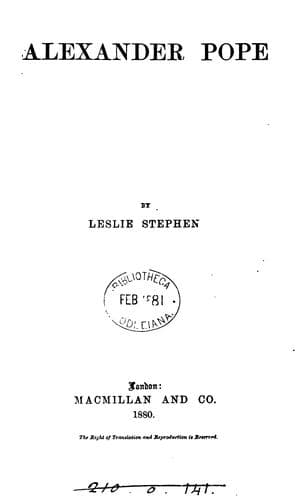
Poets, English -- 18th century -- Biography; Pope, Alexander, 1688-1744
In the worst inn's worst room, with mat half-hung,
The floors of plaister and the walls of dung,
On once a flock-bed but repair'd with straw,
With tape-ty'd curtains never meant to draw,
The George and Garter dangling from that bed,
Where tawdry yellow strove with dirty red,
Great Villiers lies! alas, how changed from him,
That life of pleasure and that soul of whim!
Gallant and gay in Cliveden's proud alcove,
The bower of wanton Shrewsbury and love;
As great as gay, at council in a ring
Of mimick'd statesmen, and their merry king.
No wit to flatter left of all his store!
No fool to laugh at, which he valued more.
Thus, victor of his health, of fortune, friends,
And fame, the lord of useless thousands ends.
It is as graphic as a page of Dickens, and has the advantage of being
less grotesque, if the sentiment is equally obvious. When Pope has made
his hit, he does not blur the effect by trying to repeat it.
In these epistles, it must be owned that the sentiment is not only
obvious but prosaic. The moral maxims are delivered like advice offered
by one sensible man to another, not with the impassioned fervour of a
prophet. Nor can Pope often rise to that level at which alone satire is
transmuted into the higher class of poetry. To accomplish that feat, if,
indeed, it be possible, the poet must not simply ridicule the fantastic
tricks of poor mortals, but show how they appear to the angels who weep
over them. The petty figures must be projected against a background of
the infinite, and we must feel the relations of our tiny eddies of life
to the oceanic currents of human history. Pope can never rise above the
crowd. He is looking at his equals, not contemplating them from the
height which reveals their insignificance. The element, which may fairly
be called poetical, is derived from an inferior source; but sometimes
has passion enough in it to lift him above mere prose.
In one of his most animated passages, Pope relates his desire to--
Brand the bold front of shameless guilty men,
Dash the proud gamester in his gilded car,
Bare the mean heart that lurks beneath a star.
For the moment he takes himself seriously; and, indeed, he seems to have
persuaded both himself and his friends that he was really a great
defender of virtue. Arbuthnot begged him, almost with his dying breath,
to continue his "noble disdain and abhorrence of vice," and, with a due
regard to his own safety, to try rather to reform than chastise; and
Pope accepts the office ostentatiously. His provocation is "the strong
antipathy of good to bad," and he exclaims,--
Yes! I am proud--I must be proud to see
Men not afraid of God, afraid of me.
Safe from the bar, the pulpit, and the throne,
Yet touch'd and shamed by ridicule alone.
Public-domain text, read in full here on John Shaqi.
Reviews
Reviews
No reviews yet
Be the first to share your thoughts on this work.
Elsewhere in the archive
Join the Discussion
Join the discussion
Sign in to leave a comment or review.
Sign InorCreate an account