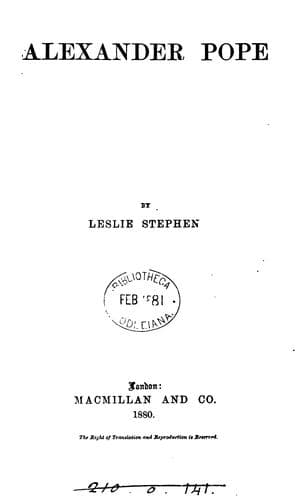
Poets, English -- 18th century -- Biography; Pope, Alexander, 1688-1744
If the sentiment provokes a slight incredulity, it is yet worth while
to understand its real meaning; and the explanation is not very far to
seek.
Pope's best writing, I have said, is the essence of conversation. It has
the quick movement, the boldness and brilliance, which we suppose to be
the attributes of the best talk. Of course the apparent facility is due
to conscientious labour. In the Prologue and Epilogue and the best parts
of the imitations of Horace, he shows such consummate mastery of his
peculiar style, that we forget the monotonous metre. The opening
passage, for example, of the Prologue is written apparently with the
perfect freedom of real dialogue; in fact, it is of course far more
pointed and compressed than any dialogue could ever be. The dramatic
vivacity with which the whole scene is given, shows that he could use
metre as the most skilful performer could command a musical instrument.
Pope, indeed, shows in the Essay on Criticism, that his view about the
uniformity of sound and sense were crude enough; they are analogous to
the tricks by which a musician might decently imitate the cries of
animals or the murmurs of a crowd; and his art excludes any attempt at
rivalling the melody of the great poets who aim at producing a harmony
quite independent of the direct meaning of their words. I am only
speaking of the felicity with which he can move in metre, without the
slightest appearance of restraint, so as to give a kind of idealized
representation of the tone of animated verbal intercourse. Whatever
comes within this province he can produce with admirable fidelity. Now
in such talks as we imagine with Swift and Bolingbroke, we may be quite
sure that there would be some very forcible denunciation of
corruption--corruption being of course regarded as due to the diabolical
agency of Walpole. During his later years, Pope became a friend of all
the Opposition clique, which was undermining the power of the great
minister. In his last letters to Swift, Pope speaks of the new circle of
promising patriots who were rising round him, and from whom he
entertained hopes of the regeneration of this corrupt country.
Sentiments of this kind were the staple talk of the circles in which he
moved; and all the young men of promise believed, or persuaded
themselves to fancy, that a political millennium would follow the
downfall of Walpole. Pope, susceptible as always to the influences of
his social surroundings, took in all this, and delighted in figuring
himself as the prophet of the new era and the denouncer of wickedness in
high places. He sees "old England's genius" dragged in the dust, hears
the black trumpet of vice proclaiming that "not to be corrupted is the
shame," and declares that he will draw the last pen for freedom, and use
his "sacred weapon" in truth's defence.
Public-domain text, read in full here on John Shaqi.
Reviews
Reviews
No reviews yet
Be the first to share your thoughts on this work.
Elsewhere in the archive
Join the Discussion
Join the discussion
Sign in to leave a comment or review.
Sign InorCreate an account