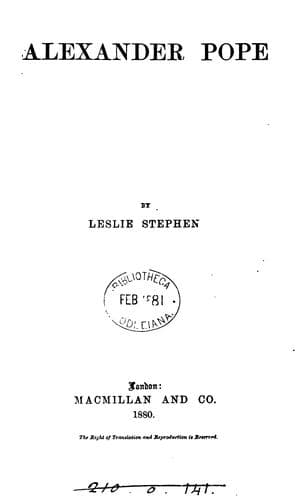
Poets, English -- 18th century -- Biography; Pope, Alexander, 1688-1744
One point remains to be briefly noticed. The virtue on which Pope prided
himself was correctness; and I have interpreted this to mean the quality
which is gained by incessant labour, guided by quick feeling, and always
under the strict supervision of common sense. The next literary
revolution led to a depreciation of this quality. Warton (like Macaulay
long afterwards) argued that in a higher sense, the Elizabethan poets
were really as correct as Pope. Their poetry embodied a higher and more
complex law, though it neglected the narrow cut-and-dried precepts
recognized in the Queen Anne period. The new school came to express too
undiscriminating a contempt for the whole theory and practice of Pope
and his followers. Pope, said Cowper, and a thousand critics have echoed
his words,--
Made poetry a mere mechanic art
And every warbler had his tune by heart.
Without discussing the wider question, I may here briefly remark that
this judgment, taken absolutely, gives a very false impression of Pope's
artistic quality. Pope is undoubtedly monotonous. Except in one or two
lyrics, such as the Ode on St. Cecilia's Day, which must be reckoned
amongst his utter failures, he invariably employed the same metre. The
discontinuity of his style, and the strict rules which he adopted, tend
to disintegrate his poems. They are a series of brilliant passages,
often of brilliant couplets, stuck together in a conglomerate; and as
the inferior connecting matter decays, the interstices open and allow
the whole to fall into ruin. To read a series of such couplets, each
complete in itself, and each so constructed as to allow of a very small
variety of form, is naturally to receive an impression of monotony.
Pope's antitheses fall into a few common forms, which are repeated over
and over again, and seem copy to each other. And, in a sense, such work
can be very easily imitated. A very inferior artist can obtain most of
his efforts, and all the external qualities of his style. One
ten-syllabled rhyming couplet, with the whole sense strictly confined
within its limits, and allowing only of such variety as follows from
changing the pauses, is undoubtedly very much like another. And
accordingly one may read in any collection of British poets innumerable
pages of versification which--if you do not look too close--are exactly
like Pope. All poets who have any marked style are more or less
imitable; in the present age of revivals, a clever versifier is capable
of adopting the manners of his leading contemporaries, or that of any
poet from Spenser to Shelley or Keats. The quantity of work scarcely
distinguishable from that of the worst passages in Mr. Tennyson, Mr.
Browning, and Mr. Swinburne, seems to be limited only by the supply of
stationery at the disposal of practised performers. That which makes the
imitations of Pope prominent is partly the extent of his sovereignty;
the vast number of writers who confined themselves exclusively to his
Public-domain text, read in full here on John Shaqi.
Reviews
Reviews
No reviews yet
Be the first to share your thoughts on this work.
Elsewhere in the archive
Join the Discussion
Join the discussion
Sign in to leave a comment or review.
Sign InorCreate an account