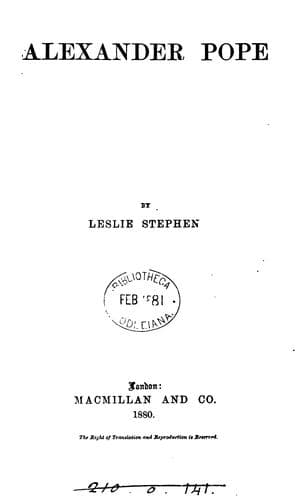
Poets, English -- 18th century -- Biography; Pope, Alexander, 1688-1744
To imagine Pope at his best, we must place ourselves in Twickenham on
some fine day, when the long disease has relaxed its grasp for a moment;
when he has taken a turn through his garden, and comforted his poor
frame with potted lampreys and a glass or two from his frugal pint.
Suppose two or three friends to be sitting with him, the stately
Bolingbroke or the mercurial Bathurst, with one of the patriotic hopes
of mankind, Marchmont or Lyttelton, to stimulate his ardour, and the
amiable Spence, or Mrs. Patty Blount to listen reverentially to his
morality. Let the conversation kindle into vivacity, and host and guests
fall into a friendly rivalry, whetting each other's wits by lively
repartee, and airing the little fragments of worldly wisdom which pass
muster for profound observation at Court; for a time they talk
platitudes, though striking out now and then brilliant flashes, as from
the collision of polished rapiers; they diverge, perhaps, into
literature, and Pope shines in discussing the secrets of the art to
which his whole life has been devoted with untiring fidelity. Suddenly
the mention of some noted name provokes a startling outburst of personal
invective from Pope; his friends judiciously divert the current of wrath
into a new channel, and he becomes for the moment a generous patriot
declaiming against the growth of luxury; the mention of some
sympathizing friend brings out a compliment, so exquisitely turned, as
to be a permanent title of honour, conferred by genius instead of power;
or the thought of his parents makes his voice tremble, and his eyes
shine with pathetic softness; and you forgive the occasional affectation
which you can never quite forget, or even the occasional grossness or
harshness of sentiment which contrasts so strongly with the superficial
polish. A genuine report of even the best conversation would be
intolerably prosy and unimaginative. But imagine the very pith and
essence of such talk brought to a focus, concentrated into the smallest
possible space with the infinite dexterity of a thoroughly trained hand,
and you have the kind of writing in which Pope is unrivalled; polished
prose with occasional gleams of genuine poetry--the epistle to Arbuthnot
and the epilogue to the Satires.
Public-domain text, read in full here on John Shaqi.
Reviews
Reviews
No reviews yet
Be the first to share your thoughts on this work.
Elsewhere in the archive
Join the Discussion
Join the discussion
Sign in to leave a comment or review.
Sign InorCreate an account