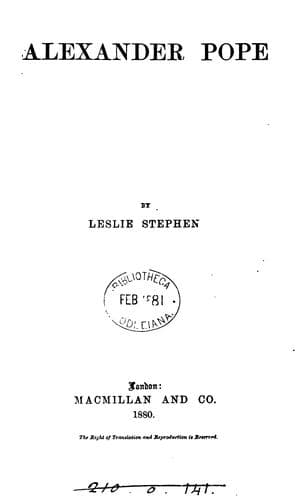
Poets, English -- 18th century -- Biography; Pope, Alexander, 1688-1744
The last satires were published in 1738. Six years of life still
remained to Pope; his intellectual powers were still vigorous, and his
pleasure in their exercise had not ceased. The only fruit, however, of
his labours during this period was the fourth book of the Dunciad. He
spent much time upon bringing out new editions of his works, and upon
the various intrigues connected with the Swift correspondence. But his
health was beginning to fail. The ricketty framework was giving way, and
failing to answer the demands of the fretful and excitable brain. In the
spring of 1744 the poet was visibly breaking up; he suffered from
dropsical asthma, and seems to have made matters worse by putting
himself in the hands of a notorious quack--a Dr. Thomson. The end was
evidently near as he completed his fifty-sixth year. Friends, old and
new, were often in attendance. Above all, Bolingbroke, the venerated
friend of thirty years' standing; Patty Blount, the woman whom he loved
best; and the excellent Spence, who preserved some of the last words of
the dying man. The scene, as he saw it, was pathetic; perhaps it is not
less pathetic to us, for whom it has another side as of grim tragic
humour.
Three weeks before his death Pope was sending off copies of the Ethic
Epistles--apparently with the Atossa lines--to his friends. "Here I am,
like Socrates," he said, "dispensing my morality amongst my friends just
as I am dying." Spence watched him as anxiously as his disciples watched
Socrates. He was still sensible to kindness. Whenever Miss Blount came
in, the failing spirits rallied for a moment. He was always saying
something kindly of his friends, "as if his humanity had outlasted his
understanding." Bolingbroke, when Spence made the remark, said that he
had never known a man with so tender a heart for his own friends or for
mankind. "I have known him," he added, "these thirty years, and value
myself more for that man's love than--" and his voice was lost in tears.
At moments Pope could still be playful. "Here I am, dying of a hundred
good symptoms," he replied to some flattering report, but his mind was
beginning to wander. He complained of seeing things as through a
curtain. "What's that?" he said, pointing to the air, and then, with a
smile of great pleasure, added softly, "'twas a vision." His religious
sentiments still edified his hearers. "I am so certain," he said, "of
the soul's being immortal, that I seem to feel it within me, as it were
by intuition;" and early one morning he rose from bed and tried to begin
an essay upon immortality, apparently in a state of semi-delirium. On
his last day he sacrificed, as Chesterfield rather cynically observes,
his cock to AEsculapius. Hooke, a zealous Catholic friend, asked him
whether he would not send for a priest. "I do not suppose that it is
essential," said Pope, "but it will look right, and I heartily thank you
for putting me in mind of it." A priest was brought, and Pope received
Public-domain text, read in full here on John Shaqi.
Reviews
Reviews
No reviews yet
Be the first to share your thoughts on this work.
Elsewhere in the archive
Join the Discussion
Join the discussion
Sign in to leave a comment or review.
Sign InorCreate an account