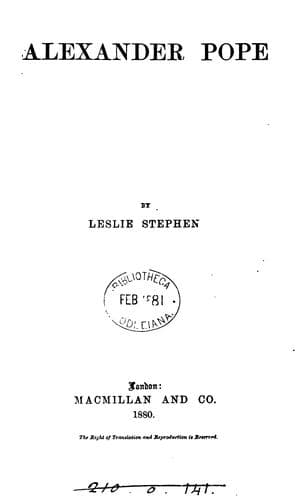
Poets, English -- 18th century -- Biography; Pope, Alexander, 1688-1744
the last sacraments with great fervour and resignation. Next day, on May
30th, 1744, he died so peacefully that his friends could not determine
the exact moment of death.
It was a soft and touching end; and yet we must once more look at the
other side. Warburton and Bolingbroke both appear to have been at the
side of the dying man, and before very long they were to be quarrelling
over his grave. Pope's will showed at once that his quarrels were hardly
to end with his death. He had quarrelled, though the quarrel had been
made up, with the generous Allen, for some cause not ascertainable,
except that it arose from the mutual displeasure of Mrs. Allen and Miss
Blount. It is pleasant to notice that, in the course of the quarrel,
Pope mentioned Warburton, in a letter to Miss Blount, as a sneaking
parson; but Warburton was not aware of the flash of sarcasm. Pope, as
Johnson puts it, "polluted his will with female resentment." He left a
legacy of 150_l._ to Allen, being, as he added, the amount received from
his friend--for himself or for charitable purposes; and requested Allen,
if he should refuse the legacy for himself, to pay it to the Bath
Hospital. Allen adopted this suggestion, saying quietly that Pope had
always been a bad accountant, and would have come nearer the truth if he
had added a cypher to the figures.
Another fact came to light, which produced a fiercer outburst. Pope, it
was found, had printed a whole edition (1500 copies) of the _Patriot
King_, Bolingbroke's most polished work. The motive could have been
nothing but a desire to preserve to posterity what Pope considered to be
a monument worthy of the highest genius, and was so far complimentary to
Bolingbroke. Bolingbroke, however, considered it as an act of gross
treachery. Pope had received the work on condition of keeping it
strictly private, and showing it to only a few friends. Moreover, he
had corrected it, arranged it, and altered or omitted passages according
to his own taste, which naturally did not suit the author's. In 1749
Bolingbroke gave a copy to Mallet for publication, and prefixed an angry
statement to expose the breach of trust of "a man on whom the author
thought he could entirely depend." Warburton rushed to the defence of
Pope and the demolition of Bolingbroke. A savage controversy followed,
which survives only in the title of one of Bolingbroke's pamphlets, A
Familiar Epistle to the most Impudent Man living--a transparent
paraphrase for Warburton. Pope's behaviour is too much of a piece with
previous underhand transactions, but scarcely deserves further
condemnation.
Public-domain text, read in full here on John Shaqi.
Reviews
Reviews
No reviews yet
Be the first to share your thoughts on this work.
Elsewhere in the archive
Join the Discussion
Join the discussion
Sign in to leave a comment or review.
Sign InorCreate an account