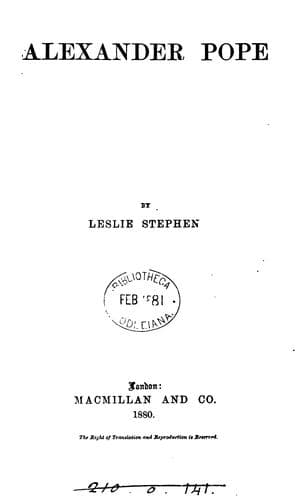
Poets, English -- 18th century -- Biography; Pope, Alexander, 1688-1744
Campbell, Byron, Roscoe, and others, and which incidentally cleared up
some disputed questions. Roscoe, the author of the Life of Leo X.,
published his edition of Pope in 1824. A life is contained in the first
volume, but it is a feeble performance; and the notes, many of them
directed against Bowles, are of little value. A more complete biography
was published by R. Carruthers (with an edition of the works), in 1854.
The second, and much improved, edition appeared in 1857, and is still
the most convenient life of Pope, though Mr. Carruthers was not fully
acquainted with the last results of some recent investigations, which
have thrown a new light upon the poet's career.
The writer who took the lead in these inquiries was the late Mr. Dilke.
Mr. Dilke published the results of his investigations (which were partly
guided by the discovery of a previously unpublished correspondence
between Pope and his friend Caryll), in the _Athenaeum_ and _Notes and
Queries_, at various intervals, from 1854 to 1860. His contributions to
the subject have been collated in the first volume of the _Papers of a
Critic_, edited by his grandson, the present Sir Charles W. Dilke, in
1875. Meanwhile Mr. Croker had been making an extensive collection of
materials for an exhaustive edition of Pope's works, in which he was to
be assisted by Mr. Peter Cunningham. After Croker's death these
materials were submitted by Mr. Murray to Mr. Whitwell Elwin, whose own
researches have greatly extended our knowledge, and who had also the
advantage of Mr. Dilke's advice. Mr. Elwin began, in 1871, the
publication of the long-promised edition. It was to have occupied ten
volumes--five of poems and five of correspondence, the latter of which
was to include a very large proportion of previously unpublished matter.
Unfortunately for all students of English literature, only two volumes
of poetry and three of correspondence have appeared. The notes and
prefaces, however, contain a vast amount of information, which clears up
many previously disputed points in the poet's career; and it is to be
hoped that the materials collected for the remaining volumes will not be
ultimately lost. It is easy to dispute some of Mr. Elwin's critical
opinions, but it would be impossible to speak too highly of the value of
his investigations of facts. Without a study of his work, no adequate
knowledge of Pope is attainable.
Public-domain text, read in full here on John Shaqi.
Reviews
Reviews
No reviews yet
Be the first to share your thoughts on this work.
Join the Discussion
Join the discussion
Sign in to leave a comment or review.
Sign InorCreate an account