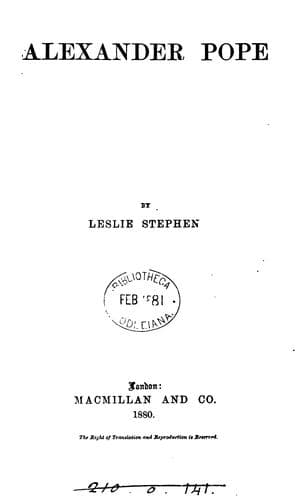
Poets, English -- 18th century -- Biography; Pope, Alexander, 1688-1744
a familiar line Pope gives us the view which he would himself apply in
such cases.
True wit is nature to advantage dress'd,
What oft was thought, but ne'er so well express'd.
The only fair question, in short, is whether Pope has managed to give a
lasting form to some of the floating commonplaces which have more or
less suggested themselves to every writer. If we apply this test, we
must admit that if the essay upon criticism does not show deep thought,
it shows singular skill in putting old truths. Pope undeniably succeeded
in hitting off many phrases of marked felicity. He already showed the
power, in which he was probably unequalled, of coining aphorisms out of
commonplace. Few people read the essay now, but everybody is aware that
"fools rush in where angels fear to tread," and has heard the warning--
A little learning is a dangerous thing,
Drink deep, or taste not the Pierian spring--
maxims which may not commend themselves as strictly accurate to a
scientific reasoner, but which have as much truth as one can demand from
an epigram. And besides many sayings which share in some degree their
merit, there are occasional passages which rise, at least, to the height
of graceful rhetoric if they are scarcely to be called poetical. One
simile was long famous, and was called by Johnson the best in the
language. It is that in which the sanguine youth, overwhelmed by a
growing perception of the boundlessness of possible attainments, is
compared to the traveller crossing the mountains, and seeing--
Hills peep o'er hills and Alps on Alps arise.
The poor simile is pretty well forgotten, but is really a good specimen
of Pope's brilliant declamation.
Public-domain text, read in full here on John Shaqi.
Reviews
Reviews
No reviews yet
Be the first to share your thoughts on this work.
Join the Discussion
Join the discussion
Sign in to leave a comment or review.
Sign InorCreate an account