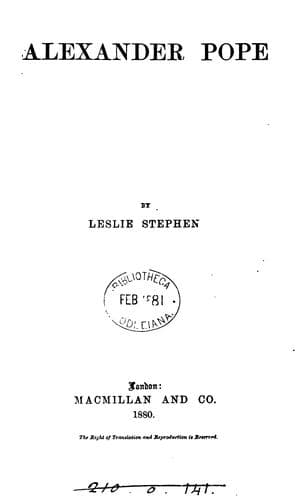
Poets, English -- 18th century -- Biography; Pope, Alexander, 1688-1744
The _Rape of the Lock_
appeared in its new form, with sylphs and gnomes, and an ingenious
account of a game at cards and other improvements, in 1714. Pope
declared, and critics have agreed, that he never showed more skill than
in the remodelling of this poem; and it has ever since held a kind of
recognised supremacy amongst the productions of the drawing-room muse.
The reader must remember that the so-called heroic style of Pope's
period is now hopelessly effete. No human being would care about
machinery and the rules of Bossu, or read without utter weariness the
mechanical imitations of Homer and Virgil which were occasionally
attempted by the Blackmores and other less ponderous versifiers. The
shadow grows dim with the substance. The burlesque loses its point when
we care nothing for the original; and, so far, Pope's bit of
filigree-work, as Hazlitt calls it, has become tarnished. The very
mention of beaux and belles suggests the kind of feeling with which we
disinter fragments of old-world finery from the depths of an ancient
cabinet, and even the wit is apt to sound wearisome. And further, it
must be allowed to some hostile critics that Pope has a worse defect.
The poem is, in effect, a satire upon feminine frivolity. It continues
the strain of mockery against hoops and patches and their wearers, which
supplied Addison and his colleagues with the materials of so many
_Spectators_. I think that even in Addison there is something which
rather jars upon us. His persiflage is full of humour and kindliness,
but underlying it there is a tone of superiority to women which is
sometimes offensive. It is taken for granted that a woman is a fool, or
at least should be flattered if any man condescends to talk sense to
her. With Pope this tone becomes harsher, and the merciless satirist
begins to show himself. In truth, Pope can be inimitably pungent, but he
can never be simply playful. Addison was too condescending with his
pretty pupils; but under Pope's courtesy there lurks contempt, and his
smile has a disagreeable likeness to a sneer. If Addison's manner
sometimes suggests the blandness of a don who classes women with the
inferior beings unworthy of the Latin grammar, Pope suggests the
brilliant wit whose contempt has a keener edge from his resentment
against fine ladies blinded to his genius by his personal deformity.
Even in his dedication, Pope, with unconscious impertinence, insults his
heroine for her presumable ignorance of his critical jargon. His smart
epigrams want but a slight change of tone to become satire. It is the
same writer who begins an essay on women's characters by telling a woman
that her sex is a compound of
Matter too soft a lasting mask to bear;
And best distinguished by black, brown, or fair,
and communicates to her the pleasant truth that
Every woman is at heart a rake.
Public-domain text, read in full here on John Shaqi.
Reviews
Reviews
No reviews yet
Be the first to share your thoughts on this work.
Join the Discussion
Join the discussion
Sign in to leave a comment or review.
Sign InorCreate an account