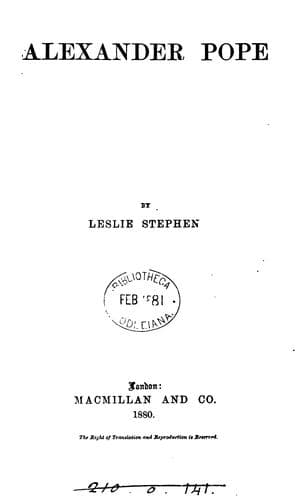
Poets, English -- 18th century -- Biography; Pope, Alexander, 1688-1744
The literary world, in which Dryden had recently been, and Pope was soon
to be, the most conspicuous figure, was for the present under the mild
dictatorship of Addison. We know Addison as one of the most kindly and
delicate of humourists, and we can perceive the gentleness which made
him one of the most charming of companions in a small society. His sense
of the ludicrous saved him from the disagreeable ostentation of powers
which were never applied to express bitterness of feeling or to edge
angry satire. The reserve of his sensitive nature made access difficult,
but he was so transparently modest and unassuming that his shyness was
not, as is too often the case, mistaken for pride. It is easy to
understand the posthumous affection which Macaulay has so eloquently
expressed, and the contemporary popularity which, according to Swift,
would have made people unwilling to refuse him had he asked to be king.
And yet I think that one cannot read Addison's praises without a certain
recalcitration, like that which one feels in the case of the model boy
who wins all the prizes, including that for good conduct. It is hard to
feel very enthusiastic about a virtue whose dictates coincide so
precisely with the demands of decorum, and which leads by so easy a path
to reputation and success. Popularity is more often significant of the
tact which makes a man avoid giving offence, than of the warm impulses
of a generous nature. A good man who mixes with the world ought to be
hated, if not to hate. But whatever we may say against his excessive
goodness, Addison deserved and received universal esteem, which in some
cases became enthusiastic. Foremost amongst his admirers was the
warm-hearted, reckless, impetuous Steele, the typical Irishman; and
amongst other members of his little senate--as Pope called it--were
Ambrose Philips and Tickell, young men of letters and sound Whig
politics, and more or less competitors of Pope in literature. When Pope
was first becoming known in London the Whigs were out of power; Addison
and his friends were generally to be found at Button's Coffee-house in
the afternoon, and were represented to the society of the time by the
_Spectator_, which began in March, 1711, and appeared daily to the end
of 1712. Naturally, the young Pope would be anxious to approach this
famous clique, though his connexions lay in the first instance amongst
the Jacobite and Catholic families. Steele, too, would be glad to
welcome so promising a contributor to the _Spectator_ and its successor
the _Guardian_.
Public-domain text, read in full here on John Shaqi.
Reviews
Reviews
No reviews yet
Be the first to share your thoughts on this work.
Join the Discussion
Join the discussion
Sign in to leave a comment or review.
Sign InorCreate an account