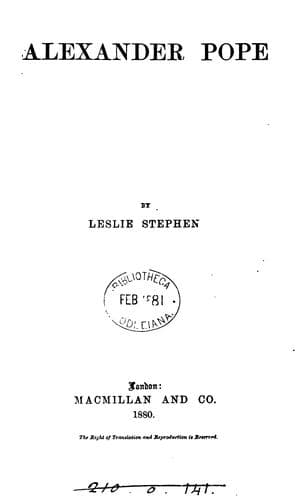
Poets, English -- 18th century -- Biography; Pope, Alexander, 1688-1744
At home, indeed, he appears to have been generally abstemious. Probably
the habits of his parents' little household were very simple; and Pope,
like Swift, knew the value of independence well enough to be
systematically economical. Swift, indeed, had a more generous heart, and
a lordly indifference to making money by his writings, which Pope, who
owed his fortune chiefly to his Homer, did not attempt to rival. Swift
alludes in his letters to an anecdote, which we may hope does not
represent his habitual practice. Pope, it appears, was entertaining a
couple of friends, and when four glasses had been consumed from a pint,
retired, saying, "Gentlemen I leave you to your wine." I tell that story
to everybody, says Swift, "in commendation of Mr. Pope's
abstemiousness;" but he tells it, one may guess, with something of a
rueful countenance. At times, however, it seems that Pope could give a
"splendid dinner," and show no want of the "skill and elegance which
such performances require." Pope, in fact, seems to have shown a
combination of qualities which is not uncommon, though sometimes called
inconsistent. He valued money, as a man values it who has been poor and
feels it essential to his comfort to be fairly beyond the reach of want,
and was accordingly pretty sharp at making a bargain with a publisher or
in arranging terms with a collaborator. But he could also be liberal on
occasion. Johnson says that his whole income amounted to about 800_l._ a
year, out of which he professed himself able to assign 100_l._ to
charity; and though the figures are doubtful, and all Pope's statements
about his own proceedings liable to suspicion, he appears to have been
often generous in helping the distressed with money, as well as with
advice or recommendations to his powerful friends. Pope, by his
infirmities and his talents, belonged to the dependent class of mankind.
He was in no sense capable of standing firmly upon his own legs. He had
a longing, sometimes pathetic and sometimes humiliating, for the
applause of his fellows and the sympathy of friends. With feelings so
morbidly sensitive, and with such a lamentable incapacity for
straightforward openness in any relation of life, he was naturally a
dangerous companion. He might be brooding over some fancied injury or
neglect, and meditating revenge, when he appeared to be on good terms;
when really desiring to do a service to a friend, he might adopt some
tortuous means for obtaining his ends, which would convert the service
into an injury; and, if he had once become alienated, the past
friendship would be remembered by him as involving a kind of
humiliation, and therefore supplying additional keenness to his
resentment. And yet it is plain that throughout life he was always
anxious to lean upon some stronger nature; to have a sturdy supporter
whom he was too apt to turn into an accomplice; or at least to have some
good-natured, easy-going companion, in whose society he might find
Public-domain text, read in full here on John Shaqi.
Reviews
Reviews
No reviews yet
Be the first to share your thoughts on this work.
Elsewhere in the archive
Join the Discussion
Join the discussion
Sign in to leave a comment or review.
Sign InorCreate an account