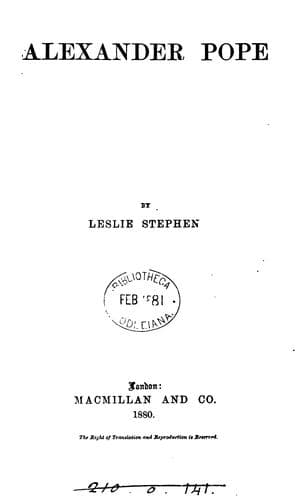
Poets, English -- 18th century -- Biography; Pope, Alexander, 1688-1744
repose for his tortured nerves. And therefore, though the story of his
friendships is unfortunately intertwined with the story of bitter
quarrels and indefensible acts of treachery, it also reveals a touching
desire for the kind of consolation which would be most valuable to one
so accessible to the pettiest stings of his enemies. He had many warm
friends, moreover, who, by good fortune or the exercise of unusual
prudence, never excited his wrath, and whom he repaid by genuine
affection. Some of these friendships have become famous, and will be
best noticed in connexion with passages in his future career. It will be
sufficient if I here notice a few names, in order to show that a
complete picture of Pope's life, if it could now be produced, would
include many figures of which we only catch occasional glimpses.
Pope, as I have said, though most closely connected with the Tories and
Jacobites, disclaimed any close party connexion, and had some relations
with the Whigs. Some courtesies even passed between him and the great
Sir Robert Walpole, whose interest in literature was a vanishing
quantity, and whose bitterest enemies were Pope's greatest friends.
Walpole, however, as we have seen, asked for preferment for Pope's old
friend, and Pope repaid him with more than one compliment. Thus, in the
Epilogue to the Satires, he says,--
Seen him I have, but in his happier hour
Of social pleasure, ill exchanged for power.
Seen him, encumber'd with the venal tribe,
Smile without art and win without a bribe.
Another Whig statesman for whom Pope seems to have entertained an
especially warm regard was James Craggs, Addison's successor as
Secretary of State, who died whilst under suspicion of peculation in the
South Sea business (1721). The Whig connexion might have been turned to
account. Craggs during his brief tenure of office offered Pope a pension
of 300_l._ a year (from the secret service money), which Pope declined,
whilst saying that, if in want of money, he would apply to Craggs as a
friend. A negotiation of the same kind took place with Halifax, who
aimed at the glory of being the great literary patron. It seems that he
was anxious to have the Homer dedicated to him, and Pope, being
unwilling to gratify him, or, as Johnson says, being less eager for
money than Halifax for praise, sent a cool answer, and the negotiation
passed off. Pope afterwards revenged himself for this offence by his
bitter satire on _Bufo_ in the Prologue to his Satires, though he had
not the courage to admit its obvious application.
Public-domain text, read in full here on John Shaqi.
Reviews
Reviews
No reviews yet
Be the first to share your thoughts on this work.
Elsewhere in the archive
Join the Discussion
Join the discussion
Sign in to leave a comment or review.
Sign InorCreate an account