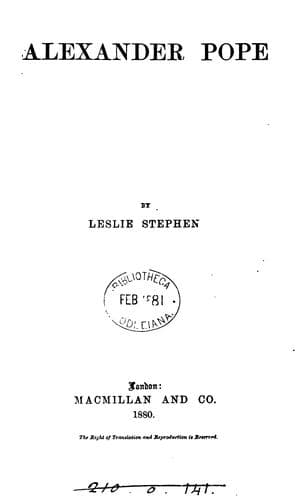
Poets, English -- 18th century -- Biography; Pope, Alexander, 1688-1744
I am sure if there be no very prevalent obstacle, you
will leave any common business to do this, and I shall hope to see you
this evening as late as you will, or to-morrow morning as early, before
this winter flower is faded." Swift's comment, on hearing the news,
gives the only consolation which Pope could have felt. "She died in
extreme old age," he writes, "without pain, under the care of the most
dutiful son I have ever known or heard of, which is a felicity not
happening to one in a million." And with her death, its most touching
and ennobling influence faded from Pope's life. There is no particular
merit in loving a mother, but few biographies give a more striking proof
that the loving discharge of a common duty may give a charm to a whole
character. It is melancholy to add that we often have to appeal to this
part of his story, to assure ourselves that Pope was really deserving of
some affection.
The part of Pope's history which naturally follows brings us again to
the region of unsolved mysteries. The one prescription which a spiritual
physician would have suggested in Pope's case would have been the love
of a good and sensible woman. A nature so capable of tender feeling and
so essentially dependent upon others, might have been at once soothed
and supported by a happy domestic life; though it must be admitted that
it would have required no common qualifications in a wife to calm so
irritable and jealous a spirit. Pope was unfortunate in his
surroundings. The bachelor society of that day, not only the society of
the Wycherleys and Cromwells, but the more virtuous society of Addison
and his friends, was certainly not remarkable for any exalted tone about
women. Bolingbroke, Peterborough, and Bathurst, Pope's most admired
friends, were all more or less flagrantly licentious; and Swift's
mysterious story shows that if he could love a woman, his love might be
as dangerous as hatred. In such a school, Pope, eminently malleable to
the opinions of his companions, was not likely to acquire a high
standard of sentiment. His personal defects were equally against him.
His frame was not adapted for the robust gallantry of the time. He
wanted a nurse rather than a wife; and if his infirmities might excite
pity, pity is akin to contempt as well as to love. The poor little
invalid, brutally abused for his deformity by such men as Dennis and his
friends, was stung beyond all self-control by their coarse laughter, and
by the consciousness that it only echoed, in a more brutal shape, the
judgment of the fine ladies of the time. His language about women,
sometimes expressing coarse contempt and sometimes rising to ferocity,
is the reaction of his morbid sensibility under such real and imagined
scorn.
Public-domain text, read in full here on John Shaqi.
Reviews
Reviews
No reviews yet
Be the first to share your thoughts on this work.
Elsewhere in the archive
Join the Discussion
Join the discussion
Sign in to leave a comment or review.
Sign InorCreate an account