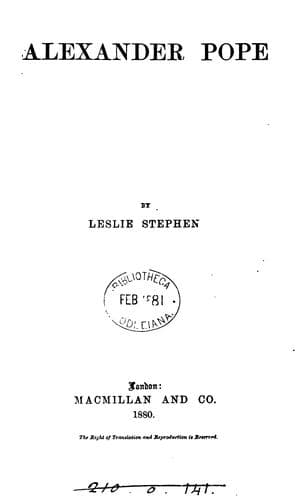
Poets, English -- 18th century -- Biography; Pope, Alexander, 1688-1744
We should be better pleased if we could restore a vivid image of the
inner circle upon which his happiness most intimately depended. In one
relation of life Pope's conduct was not only blameless, but thoroughly
loveable. He was, it is plain, the best of sons. Even here, it is true,
he is a little too consciously virtuous. Yet when he speaks of his
father and mother there are tears in his voice, and it is impossible not
to recognize genuine warmth of heart.
Me let the tender office long engage
To rock the cradle of reposing age,
With lenient arts extend a mother's breath,
Make languor smile, and soothe the bed of death,
Explore the thought, explain the asking eye,
And keep awhile one parent from the sky![8]
Such verses are a spring in the desert, a gush of the true feeling,
which contrasts with the strained and factitious sentiment in his
earlier rhetoric, and almost forces us to love the writer. Could Pope
have preserved that higher mood, he would have held our affections as he
often delights our intellect.
Unluckily we can catch but few glimpses of Pope's family life; of the
old mother and father and the affectionate nurse, who lived with him
till 1721, and died during a dangerous illness of his mother's. The
father, of whom we hear little after his early criticism of the son's
bad "rhymes," died in 1717, and a brief note to Martha Blount gives
Pope's feeling as fully as many pages: "My poor father died last night.
Believe, since I don't forget you this moment, I never shall." The
mother survived till 1733, tenderly watched by Pope, who would never be
long absent from her, and whose references to her are uniformly tender
and beautiful. One or two of her letters are preserved. "My Deare,--A
letter from your sister just now is come and gone, Mr. Mennock and
Charls Rackitt, to take his leve of us; but being nothing in it, doe not
send it.... Your sister is very well, but your brother is not. There's
Mr. Blunt of Maypell Durom is dead, the same day that Mr. Inglefield
died. My servis to Mrs. Blounts, and all that ask of me. I hope to here
from you, and that you are well, which is my dalye prayers; this with my
blessing." The old lady had peculiar views of orthography, and Pope, it
is said, gave her the pleasure of copying out some of his Homer, though
the necessary corrections gave him and the printers more trouble than
would be saved by such an amanuensis. Three days after her death he
wrote to Richardson, the painter. "I thank God," he says, "her death was
as easy as her life was innocent; and as it cost her not a groan, nor
even a sigh, there is yet upon her countenance such an expression of
tranquillity, nay, almost of pleasure, that it is even enviable to
behold it. It would afford the finest image of a saint expired that ever
painter drew, and it would be the greatest obligation which ever that
obliging art could ever bestow upon a friend, if you would come and
sketch it for me.
Public-domain text, read in full here on John Shaqi.
Reviews
Reviews
No reviews yet
Be the first to share your thoughts on this work.
Elsewhere in the archive
Join the Discussion
Join the discussion
Sign in to leave a comment or review.
Sign InorCreate an account