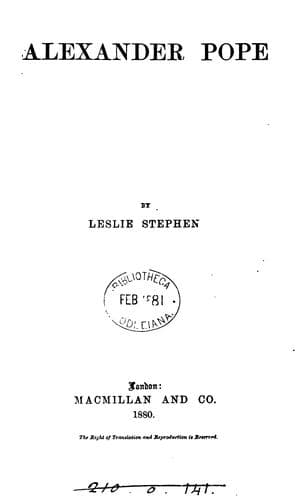
Poets, English -- 18th century -- Biography; Pope, Alexander, 1688-1744
His father corrected his early performances and when not satisfied, sent
him back with the phrase, "These are not good rhymes." He translated any
passages that struck him in his reading, excited by the examples of
Ogilby's Homer and Sandys' Ovid. His boyish ambition prompted him before
he was fifteen to attempt an epic poem; the subject was Alcander, Prince
of Rhodes, driven from his home by Deucalion, father of Minos; and the
work was modestly intended to emulate in different passages the beauties
of Milton, Cowley, Spenser, Statius, Homer, Virgil, Ovid, and Claudian.
Four books of this poem survived for a long time, for Pope had a more
than parental fondness for all the children of his brain, and always had
an eye to possible reproduction. Scraps from this early epic were worked
into the Essay on Criticism and the Dunciad. This couplet, for example,
from the last work comes straight, we are told, from Alcander,--
As man's Maeanders to the vital spring
Roll all their tides, then back their circles bring.
Another couplet, preserved by Spence, will give a sufficient taste of
its quality:--
Shields, helms, and swords all jangle as they hang,
And sound formidinous with angry clang.
After this we shall hardly censure Atterbury for approving (perhaps
suggesting) its destruction in later years. Pope long meditated another
epic, relating the foundation of the English government by Brutus of
Troy, with a superabundant display of didactic morality and religion.
Happily this dreary conception, though it occupied much thought, never
came to the birth.
Public-domain text, read in full here on John Shaqi.
Reviews
Reviews
No reviews yet
Be the first to share your thoughts on this work.
Join the Discussion
Join the discussion
Sign in to leave a comment or review.
Sign InorCreate an account