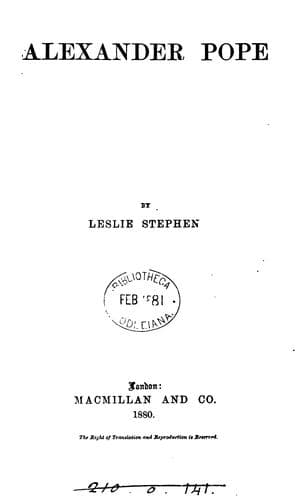
Poets, English -- 18th century -- Biography; Pope, Alexander, 1688-1744
It was the dislike of a charlatan for the excellence which he
endeavoured to simulate. Bolingbroke, it may be added, was equally
contemptuous in his language about men of learning, and for much the
same reason. He depreciated what he could not rival. Pope, always under
the influence of some stronger companions, naturally adopted their
shallow prejudices, and recklessly abused a writer who should have been
recognized as amongst the most effective combatants against dulness.
Bentley died a few months after the publication of the Dunciad. But Pope
found a living antagonist, who succeeded in giving him pain enough to
gratify the vilified dunces. This was Colley Cibber--most lively and
mercurial of actors--author of some successful plays, with too little
stuff in them for permanence, and of an Apology for his own Life, which
is still exceedingly amusing as well as useful for the history of the
stage. He was now approaching seventy, though he was to survive Pope for
thirteen years, and as good-tempered a specimen of the lively, if not
too particular, old man of the world as could well have been found. Pope
owed him a grudge. Cibber, in playing the _Rehearsal_, had introduced
some ridicule of the unlucky _Three Hours after Marriage_. Pope, he
says, came behind the scenes foaming and choking with fury, and
forbidding Cibber ever to repeat the insult. Cibber laughed at him, said
that he would repeat it as long as the _Rehearsal_ was performed, and
kept his word. Pope took his revenge by many incidental hits at Cibber,
and Cibber made a good-humoured reference to this abuse in the Apology.
Hereupon Pope, in the new Dunciad, described him as reclining on the lap
of the goddess, and added various personalities in the notes. Cibber
straightway published a letter to Pope, the more cutting because still
in perfect good-humour, and told the story about the original quarrel.
He added an irritating anecdote in order to provoke the poet still
further. It described Pope as introduced by Cibber and Lord Warwick to
very bad company. The story was one which could only be told by a
graceless old representative of the old school of comedy, but it hit its
mark. The two Richardsons once found Pope reading one of Cibber's
pamphlets. He said, "These things are my diversion;" but they saw his
features writhing with anguish, and young Richardson, as they went home,
observed to his father that he hoped to be preserved from such
diversions as Pope had enjoyed. The poet resolved to avenge himself, and
he did it to the lasting injury of his poem. He dethroned Theobald, who,
as a plodding antiquarian, was an excellent exponent of dulness, and
installed Cibber in his place, who might be a representative of folly,
but was as little of a dullard as Pope himself. The consequent
alterations make the hero of the poem a thoroughly incongruous figure,
and greatly injure the general design. The poem appeared in this form in
Public-domain text, read in full here on John Shaqi.
Reviews
Reviews
No reviews yet
Be the first to share your thoughts on this work.
Elsewhere in the archive
Join the Discussion
Join the discussion
Sign in to leave a comment or review.
Sign InorCreate an account