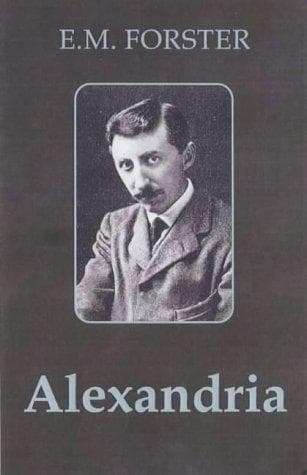
Alexandria: A History and a GuideForster, E. M. (Edward Morgan)
History
Alexandria: A History and a Guide
Forster, E. M. (Edward Morgan)
Alexandria (Egypt) -- Guidebooks; Alexandria (Egypt) -- History
But the new generation was Greek in spirit as well as speech, and
diverged increasingly from the conservative Jews at Jerusalem. Both
sections worshipped Jehovah, but the Alexandrian grew more and more
conscious of the churlishness and inaccessibility of his national god.
Thought mingled with his adoration. How could he link Jehovah to man?
And, utilising a few hints in the orthodox scriptures, he produced as
his first attempt a fine piece of literature called “The Wisdom of
Solomon”; it is at present included in the Apocrypha. The author—his
name is unknown—not only wrote in Greek but had studied Stoic and
Epicurean Philosophy and Egyptian rites. He had the cosmopolitan culture
of Alexandria. And, solving his problem in the Alexandrian way, he
conceived an intermediate between Jehovah and man whom he calls Sophia
or Wisdom.
Wisdom is more moving than any motion: she goeth through all things
by reason of her pureness. Being but one she can do all things and
in all ages entering into holy souls she makes them friends of God,
and prophets. She is more beautiful than the sun and all the order
of stars: being compared with the light she is found beyond it. For
after this cometh night, but vice shall not prevail against wisdom.
In such a passage Wisdom is more than “being wise.” She is a messenger
who bridges the gulf and makes us friends of God.
* * * * *
In Philo the Jewish school of Alexandria reaches its height. Little is
known of his life. His brother was head of the Jewish community here and
he himself was sent (A.D. 40) on a disastrous embassy to the mad Emperor
Caligula at Rome.
Being an orthodox Jew, he states his philosophic problem in the language
of the Old Testament. Thus:—
Jehovah had said I AM THAT I AM—that is to say, nothing can be
predicated about God except existence. God has no qualities, no desires,
no form, and no home. We cannot even call God “God” because “God” is a
word, and no word can describe God. While to regard him as a man is to
commit “an error greater than the sea.” God IS, and no more can be said
of him.
Yet this unapproachable being has created us. How? And why?
Through his Logos or Word. This Logos of Philo is, like “Wisdom,” a
messenger who bridges the gulf. He is the outward expression of God’s
existence. He created and he sustains the world, and Philo uses the
actual language of devotion concerning him, calling him Israel the Seer,
the Dove, the Dweller in the Inmost,—language which naturally recalls
and possibly suggested the opening of St. John’s Gospel. “In the
beginning was the Word, and the Word was with God.” Philo might have
written this. But he could not have written “the Word was God” nor “the
Word was made flesh” for it was, as we shall see, the distinction of
Christianity to conceive that the link between Man and God should be
himself both God and Man.
Public-domain text, read in full here on John Shaqi.
Reviews
Reviews
No reviews yet
Be the first to share your thoughts on this work.
Join the Discussion
Join the discussion
Sign in to leave a comment or review.
Sign InorCreate an account