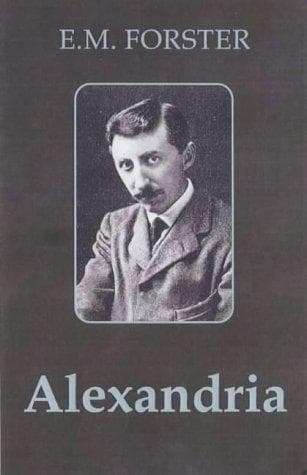
Alexandria: A History and a GuideForster, E. M. (Edward Morgan)
History
Alexandria: A History and a Guide
Forster, E. M. (Edward Morgan)
Alexandria (Egypt) -- Guidebooks; Alexandria (Egypt) -- History
CENTRE OF ROOM: Wooden stretcher on which is a mummied crocodile. It was
carried thus in procession by the priests, as the water colour below
(copy of a fresco) shows. The stretcher rests on a wooden chest, also
found in the shrine.
BACK WALL: Wooden door of the outer gateway (_see_ North Garden). Greek
inscription. Here are some photographs by which the temple can be
reconstructed.
39 (right of the chest): an offering table to the god, ornate and
unpleasing. He lies in a little tank.
LEFT OF THE ENTRANCE DOOR: Relief of a priest adoring the god, who
crawls upon lotus flowers.
ROOM 10: ANCIENT EGYPT: SMALL EXHIBITS.
IN THE ENTRANCE: Offering table, with basins for the libations.
RIGHT WALL—_Case C_; Statuettes of gods, all named. The most interesting
for the history of Alexandria are 3-25 Osiris, and 26-40 the bull Apis,
with whom he was compounded to make Serapis. (p. 18).
_Case D_: Mummies of a baby, of an eagle, of an ibis.
_Case Aa—Shelf b_ (at the top): winged scarabs in blue enamel. _Shelf k_
(No. 1): statuette of Sekhet, goddess of the heat of the sun—she has the
head of a lioness and holds a gold flower. _Shelf f_: Bast, the cat-god.
No. 39 has a kitten between the paws. 51 gold earrings. _Shelf 1_ has
more statues of Bast. 55 very good.
LEFT WALL: _Case h_ “Canopic” vases of alabaster. Used to hold those
parts of the dead that could not be embalmed. Each dedicated to a son of
Horus. Amset held the stomach; Hapi the intestines; Douamoutef the
lungs; Kebehsenouf the liver. For their connection with the town of
Canopus, _see_ p. 176.
_Case Bb_:—More statuettes—especially _shelf i_.—Harpocrates and Horus,
and _shelf k_. Isis nursing Horus—the artistic origin for the Christian
design of the Madonna and Child. (p. 69). There are some rattles and
vases of the Isis cult.
_Case L_: Little serving figures (Ushabti), which were put in the grave
with the mummy to do the work for it in the underworld.
Also round the wall of the room: six painted mummy cases.
Down the middle: two big tables of scarabs, amulets, gold trinkets, etc.
ROOM 11. GRECO-EGYPTIAN.
Objects in which the Greek and Egyptian influences mingle. They are few
in number, and not as interesting as one might expect. No living art was
born from the union.
RIGHT WALL: 18. Dedication to the Egyptian god Anubis with a Greek
inscription. 20. Profile of a Ptolemy—rather charming. 33-40. Serpent
worship—very repulsive. 40. is a curious mixture. The male snake has the
basket of Serapis and the club of Hercules; the female, the disc of Isis
and the sheaf of Ceres. 41. Bad painting, Greek style, of a girl with
Egyptian gods round her. From Gabbari.
END WALL—both sides: 43-53. Clumsy statues from the Fayoum, in which
Greek influence appears.
Public-domain text, read in full here on John Shaqi.
Reviews
Reviews
No reviews yet
Be the first to share your thoughts on this work.
Elsewhere in the archive
Join the Discussion
Join the discussion
Sign in to leave a comment or review.
Sign InorCreate an account