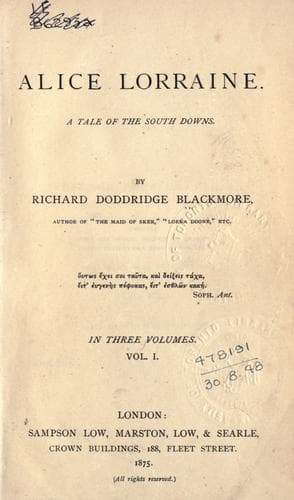
Alice Lorraine: A Tale of the South DownsBlackmore, R. D. (Richard Doddridge)
General
Alice Lorraine: A Tale of the South Downs
Blackmore, R. D. (Richard Doddridge)
Peninsular War, 1807-1814 -- Fiction; South Downs (England) -- Fiction
“Why not? I should like to know, why not? I could get to the place in
two days’ time; and the change would do me a world of good. You laity
can never understand what it is to be a parson. A deacon would come for
a guinea, and take my Sunday morning duty, and the congregation for the
afternoon would rejoice to be disappointed. And when I come back, they
will dwell on my words, because the other man will have preached so
much worse. Times are hard with me, Roland, just now. If I go, will you
pay the piper?”
“Not only that, Struan; but I shall thank you to the uttermost stretch
of gratitude.”
“There will be no gratitude on either side. I am bound to look after my
nephew’s affairs: and I sadly want to get away from home. I have heard
that there is a nice trout stream there. If Hilary, who knows all he
knows from me, could catch a fine fish, as Alice told me,--what am I
likely to do, after panting up in this red-hot chalk so long? Roland,
I must have a pipe, though you hate it. I let you sneeze; and you must
let me blow.”
“Well, Struan, you can do what you like, for this once. This is so very
kind of you.”
“I believe if you had let that boy Hilary smoke,” said the Rector,
warming unto his pipe, “you never would have had all this bother with
him about this trumpery love-affair. Cupid hates tobacco.”
CHAPTER XXVII.
A GOOD PARSON’S HOLIDAY.
On the second evening after the above discourse, a solitary horseman
might have been seen (or, to put it more indicatively, a lonely ponyman
was seen) pricking gallantly over the plains, and into the good town
of Tonbridge, in the land of Kent. Behind him, and strapped to his
saddle, he bore what used to be called a “vady;” that is to say, a
small leather cylinder, containing change of raiment, and other small
comforts of the traveller. The pony he bestrode was black, with a white
star on her forehead, a sturdy trudger, of a spirited nature, and
proud of the name of “Maggie.” She had now recovered entirely from her
ten-guinea feast of dahlias, and was as pleased as the Rector himself,
to whisk her tail in a change of air. Her pace was quite brisk, and
her ears well pricked, especially when she smelled the smell which
all country towns have of horses, and of rubbing down, hissing, and
bucketing, and (best of all) of good oats jumping in a sieve among the
chaff.
Maggie was proud of her master, and thought him the noblest man that
ever cracked a whip, having imbibed this opinion from the young smart
hunter, who was up to everything. And it might have fared ill with Jack
the donkey, if Maggie had carried her master when that vile assault was
perpetrated. But if Maggie was now in good spirits, what lofty flight
of words can rise to the elation of her rider?
Public-domain text, read in full here on John Shaqi.
Reviews
Reviews
No reviews yet
Be the first to share your thoughts on this work.
Elsewhere in the archive
Join the Discussion
Join the discussion
Sign in to leave a comment or review.
Sign InorCreate an account