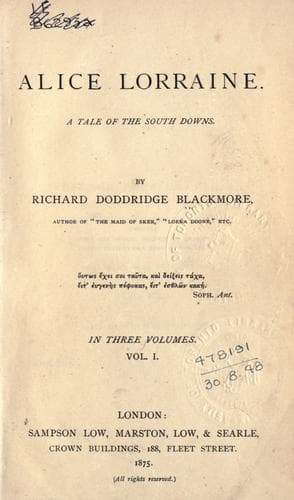
Alice Lorraine: A Tale of the South DownsBlackmore, R. D. (Richard Doddridge)
General
Alice Lorraine: A Tale of the South Downs
Blackmore, R. D. (Richard Doddridge)
Peninsular War, 1807-1814 -- Fiction; South Downs (England) -- Fiction
And now, when field, and wood, and hedge stand up in flush of
summering, and every bird, and bat, and insect of our British island
is as active as he ought to be (and sometimes much too much so); also,
when good people look at one another in hot weather, and feel that
they may have worked too hard, or been too snappish when the frosts
were on (which they always are, except in July), and then begin to
wonder whether their children would like to play with the children of
one another, because they cannot catch cold in such weather; and after
that, begin to speak of a rubber in the bower, and a great spread of
delightfulness,--when all this comes to pass, what right have we to
make the worst of it?
That is neither here nor there. Only one thing is certain, that our
good parson, looking as unlike a parson as he could--and he had a good
deal of capacity in that way--steered his pony Maggie round the corner
into the Grower’s yard, and looked about to see how the land lay. The
appearance of everything pleased him well; for comfort, simplicity,
and hospitality shared the good quarters between them. Even a captious
man could hardly, if he understood the matter, find much fault with
anything. The parson was not a captious man, and he knew what a good
farm-yard should be, and so he said “Capital, capital!” twice, before
he handed Maggie’s bridle to Paddy from Cork, who of course had run out
with a sanguine sense of a shilling arrived.
“Is Squire Lovejoy at home?” asked the visitor, being determined to
“spake the biggest,” as Paddy described it afterwards. For the moment,
however, he only stared, while the parson repeated the question.
“Is it the maisther ye mane?” said Paddy; “faix then, I’ll go, and ax
the missus.”
But before there was time to do this, the Grower appeared with a spud
on his shoulder. He had been in the hop-ground; and hearing a horse,
came up to know what was toward. The two men looked at one another,
with mutual approval. The parson tall, and strong, and lusty, and
with that straightforward aspect which is conferred, or at least
confirmed, by life in the open air, field sports, good living, and
social gatherings. His features, too, were clear and bold, and his jaws
just obstinate enough to manage a parish; without that heavy squareness
which sets church and parish by the ears. The Grower was of moderate
height, and sturdy, and thoroughly useful; his face told of many
dealings with the world; but his eyes were frank, and his mouth was
pleasant. His custom was to let other people have their say before he
spoke; and now he saluted Mr. Hales in silence, and waited for him to
begin.
“I hope,” said his visitor, “you will excuse my freedom in coming to
see you thus. I am trying this part of the country, for the first time,
for a holiday. And the landlord of the ‘Chequers Inn’ at Tonbridge,
where I am staying for a day or two, told me that you perhaps would
allow me to try for a fish in your river, sir.”
Public-domain text, read in full here on John Shaqi.
Reviews
Reviews
No reviews yet
Be the first to share your thoughts on this work.
Elsewhere in the archive
Join the Discussion
Join the discussion
Sign in to leave a comment or review.
Sign InorCreate an account