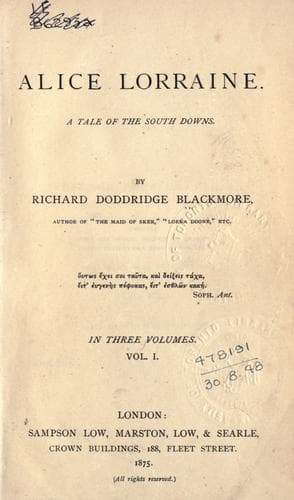
Alice Lorraine: A Tale of the South DownsBlackmore, R. D. (Richard Doddridge)
General
Alice Lorraine: A Tale of the South Downs
Blackmore, R. D. (Richard Doddridge)
Peninsular War, 1807-1814 -- Fiction; South Downs (England) -- Fiction
“In our little brook! There be none left, I think. You are kindly
welcome to try, sir. But I fear you will have a fool’s errand of it. We
have had a young gentleman from London here, a wonderful angler, sure
enough, and I do believe he hath caught every one.”
“Well, sir, with your kind permission, there can be no harm in trying,”
said the Rector, laughing, in his sleeve, at Hilary’s crude art
compared with his own. “The day is not very promising, and the water of
course is strange to me. But have I your leave to do my best?”
“Ay, ay, as long as you like. My ground goes as far up as there is any
water, and down the brook to the turnpike road. We will see to your
nag; and if you would like a bit to eat, sir, we dine at one, and we
sup at seven; and there be always a bit in the larder ’tween whiles.
Wil’t come into house before starting?”
“I thank you for the kind offer; but I think I’d better ask you the
way, and be off. There is just a nice little coil of cloud now; in an
hour it may be gone; and the brook, of course, is very low and clear.
Whatever my sport is, I shall call in and thank you, when I come back
for my pony. My name is Hales, sir, a clerk from Sussex; very much at
your service and obliged to you.”
“The same to you, Master Halls; and I wish you more sport than you will
get, sir. Your best way is over that stile; and then when you come to
the water, go where you will.”
“One more question, which I always ask; what size do you allow your
fish to be taken?”
“What size? Why, as big, to be sure, as ever you can catch them. The
bigger they are, the less bones they have.”
With a laugh at this answer, the parson set off, with his old fly-book
in his pocket, and a rod in his hand which he had borrowed (by grace
of his landlord) in Tonbridge. His step was brisk, and his eyes were
bright, and he thought much more of the sport in prospect than of the
business that brought him there.
“Aha!” he exclaimed, as he hit on the brook, where an elbow of bank
jutted over it, “very fine tackle will be wanted here, and one fly is
quite enough for it. It must be fished downward, of course, because it
cannot be fished upward. It will take all I know to tackle them.”
So it did; and a great deal more than he knew. He changed his fly
every quarter of an hour, and he tried every dodge of experience; he
even tried dapping with the natural fly, and then the blue-bottle and
grasshopper; but not a trout could he get to rise, or even to hesitate,
or show the very least sign of temptation.
So great was his annoyance (from surety of his own skill, and vain
reliance upon it), that after fishing for about ten hours, and catching
a new-born minnow, the Rector vehemently came to a halt, and repented
that he had exhausted already his whole stock of strong language. When
a good man has done this, a kind of reaction (either of the stomach or
conscience) arises, and leads him astray from his usual sign-posts,
whether of speech, or deed, or thought.
Public-domain text, read in full here on John Shaqi.
Reviews
Reviews
No reviews yet
Be the first to share your thoughts on this work.
Elsewhere in the archive
Join the Discussion
Join the discussion
Sign in to leave a comment or review.
Sign InorCreate an account