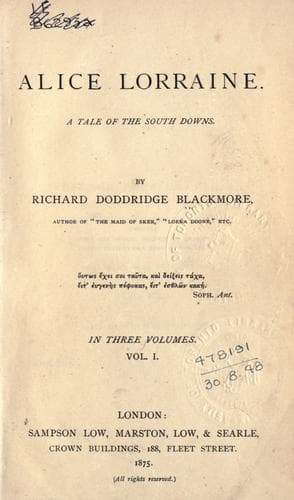
Alice Lorraine: A Tale of the South DownsBlackmore, R. D. (Richard Doddridge)
General
Alice Lorraine: A Tale of the South Downs
Blackmore, R. D. (Richard Doddridge)
Peninsular War, 1807-1814 -- Fiction; South Downs (England) -- Fiction
Sir Roland also was becoming more and more reserved and meditative.
He would sit for hours in his book-room, immersed in his favourite
studies, or rather absorbed in his misty abstractions. And Lady
Valeria did not add to the cheer of the household, although perhaps
she did increase its comfort, by suddenly ceasing to interfere with
Mrs. Pipkins and everybody else, and sending for the parson of the
next parish, because she had no faith in Mr. Hales. That worthy’s
unprofessional visits, and those of his wife and daughters, were now
almost the only pleasant incidents of the day or week. For the country
was more and more depressed by gloomy burden of endless war, the
scarcity of the fruits of the earth, and the slaughter of good brave
people. So that as the time went on, what with miserable expeditions,
pestilence, long campaigns, hard sieges, furious battles, and
starvation--there was scarcely any decent family that was not gone into
mourning.
Even the Rector, as lucky a man as ever lived, had lost a nephew, or at
least a nephew of his dear wife,--which, he said, was almost worse to
him--slain in battle, fighting hard for his country and constitution.
Mr. Hales preached a beautiful sermon, as good as a book, about it; so
that all the parish wept, and three young men enlisted.
The sheep were down in the lowlands now, standing up to their knees in
litter, and chewing very slowly; or sidling up against one another
in the joy of woolliness; or lying down, with their bare grave noses
stretched for contemplation’s sake, winking with their gentle eyes, and
thanking God for the roof above them, and the troughs in front of them.
They never regarded themselves as mutton, nor their fleeces as worsted
yarn: it was really sad to behold them, and think that the future could
not make them miserable.
No snow had fallen; but all the downs were spread with that sombre
brown which is the breath or the blast of the wind-frost. But Alice
Lorraine took her daily walk, for her father forbade her to ride on the
hill-tops in the bleak and bitter wind. Her thoughts were continually
of her brother; and as the cold breeze rattled her cloak, or sprayed
her soft hands through her gloves, many a time she said to herself: “I
suppose there is no frost in Spain; or not like this at any rate. How
could the poor fellow sleep in a tent in such dreadful weather as this
is?”
How little she dreamed that he had to sleep (whenever he got such a
blissful chance) not in a tent, but an open trench, with a keener wind
and a blacker frost preying on his shivering bones, while cannon-balls
and fiery shells in a pitiless storm rushed over him! It was no
feather-bed fight that was fought in front of Ciudad Rodrigo. About the
middle of January, A.D. 1812, desperate work was going on.
Public-domain text, read in full here on John Shaqi.
Reviews
Reviews
No reviews yet
Be the first to share your thoughts on this work.
Elsewhere in the archive
Join the Discussion
Join the discussion
Sign in to leave a comment or review.
Sign InorCreate an account