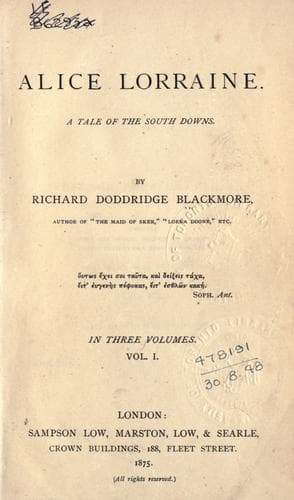
Alice Lorraine: A Tale of the South DownsBlackmore, R. D. (Richard Doddridge)
General
Alice Lorraine: A Tale of the South Downs
Blackmore, R. D. (Richard Doddridge)
Peninsular War, 1807-1814 -- Fiction; South Downs (England) -- Fiction
For now there was no time to think of life. Within a certain number
of days the fort must be taken, or the army lost. The defences were
strong, and the garrison brave, and supplied with artillery far
superior to that of the besiegers; the season also, and the bitter
weather, fought against the British; and so did the indolence of their
allies; and so did British roguery. The sappers could only work in
the dark (because of the grape from the ramparts); and working thus,
the tools either bent beneath their feet or snapped off short. The
contractor had sent out false-grained stuff, instead of good English
steel and iron; and if in this world he earned his fortune, he assured
his fate in the other.
At length by stubborn perseverance, most of these troubles were
overcome, and the English batteries opened. Roar answered roar, and
bullet bullet, and the black air was striped with fire and smoke; and
men began to study the faces of the men that shot at them, until after
some days of hard pounding, it was determined to rush in. All who care
to read of valour know what a desperate rush it was,--how strong men
struggled, and leaped, and clomb, hung, and swung, on the crest of
the breach, like stormy surges towering, and then leaped down upon
spluttering shells, drawn swords, and sparkling bayonets.
Before the signal to storm was given, and while men were talking of it,
Hilary Lorraine felt most uncomfortably nervous. He did not possess
that solid phlegm which is found more often in square-built people;
neither had he any share of fatalism, cold or hot. He was nothing
more than a spirited young Englishman, very fond of life, hating
cruelty, and fearing to have any hand in it. Although he had been in
the trenches, and exposed to frequent dangers, he had not been in
hand-to-hand conflict yet; and he knew not how he might behave. He knew
that he was an officer now in the bravest and hardiest armies known on
earth since the time of the Samnites--although perhaps not the very
best behaved, as they proved that self-same night. And not only that,
but an officer of the famous Light Division, and the fiercest regiment
of that division--everywhere known as the “Fighting-cocks”; and he was
not sure that he could fight a frog. He was sure that he never could
kill anybody, at least in his natural state of mind; and worse than
that, he was not at all sure that he could endure to be killed himself.
Public-domain text, read in full here on John Shaqi.
Reviews
Reviews
No reviews yet
Be the first to share your thoughts on this work.
Elsewhere in the archive
Join the Discussion
Join the discussion
Sign in to leave a comment or review.
Sign InorCreate an account