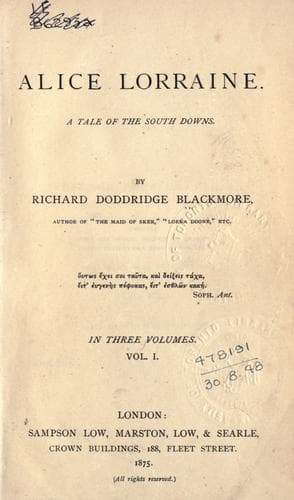
Alice Lorraine: A Tale of the South DownsBlackmore, R. D. (Richard Doddridge)
General
Alice Lorraine: A Tale of the South Downs
Blackmore, R. D. (Richard Doddridge)
Peninsular War, 1807-1814 -- Fiction; South Downs (England) -- Fiction
However, he made preparation for it. He brought out the Testament Mabel
had given him as a parting keepsake, in the moment of true love’s
piety; and he opened it at a passage marked with a woven tress of
her long rich hair--“Soldiers, do that is commanded of you;” and he
wondered whether he could manage it. And while he was trembling, not
with the fear of the enemy, but of his own young heart, the Colonel of
that regiment came, and laid his one hand on Hilary’s shoulder, and
looked into his bright blue eyes. In all the army there was no braver,
nobler, or kinder-hearted man, than Colonel C---- of that regiment.
Hilary looked at this true veteran with all the reverence, and even
awe, which a young subaltern (if fit for anything) feels for commanding
experience. Never a word he spoke, however, but waited to be spoken to.
“You will do, lad. You will do,” said the Colonel, who had little time
to spare. “I would rather see you like that, than uproarious, or even
as cool as a cucumber. I was just like that, before my first action.
Lorraine, you will not disgrace your family, your country, or your
regiment.”
The Colonel had lost two sons in battle, younger men than Hilary,
otherwise he might not have stopped to enter into an ensign’s mind. But
every word he spoke struck fire in the heart of this gentle youth. True
gratitude chokes common answers; and Hilary made none to him. An hour
afterwards he made it, by saving the life of the Colonel.
The Light Division (kept close and low from the sight of the sharp
French gunners) were waiting in a hollow curve of the inner parallel,
where the ground gave way a little, under San Francisco. There had been
no time to do anything more than breach the stone of the ramparts; all
the outer defences were almost as sound as ever. The Light Division had
orders to carry the lesser breach--cost what it might--and then sweep
the ramparts as far as the main breach, where the strong assault was.
And so well did they do their work, that they turned the auxiliary into
the main attack, and bodily carried the fortress.
For, sooth to say, they expected, but could not manage to wait for,
the signal to storm. No sooner did they hear the firing on the right
than they began to stamp and swear; for the hay-bags they were to throw
into the ditch were not at hand, and not to be seen. “Are we horses,
to wait for the hay?” cried an Irishman of the Fifty-second; and with
that they all set off as fast as ever their legs could carry them.
Hilary laughed--for his sense of humour was never very far to seek--at
the way in which these men set off, as if it were a game of football;
and at the wonderful mixture of fun and fury in their faces. Also, at
this sudden burlesque of the tragedy he expected--with heroes out at
heels and elbows, and small-clothes streaming upon the breeze. For the
British Government, as usual, left coats, shoes, and breeches, to last
for ever.
Public-domain text, read in full here on John Shaqi.
Reviews
Reviews
No reviews yet
Be the first to share your thoughts on this work.
Elsewhere in the archive
Join the Discussion
Join the discussion
Sign in to leave a comment or review.
Sign InorCreate an account