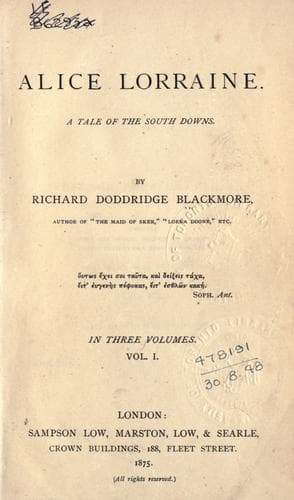
Alice Lorraine: A Tale of the South DownsBlackmore, R. D. (Richard Doddridge)
General
Alice Lorraine: A Tale of the South Downs
Blackmore, R. D. (Richard Doddridge)
Peninsular War, 1807-1814 -- Fiction; South Downs (England) -- Fiction
The following afternoon the master of Coombe Lorraine was sent for,
to have a long talk with his mother about matters of business. Now
Sir Roland particularly hated business; his income was enough for all
his wants; his ambition (if ever he had any) was a vague and vaporous
element; he left to his lawyers all matters of law; and even the
management of his land, but for his mother’s strong opposition, he
would gladly have left to a steward or agent, although the extent of
his property scarcely justified such an appointment. So he entered his
mother’s room that day with a languid step and reluctant air.
The lady paid very little heed to that. Perhaps she even enjoyed
it a little. Holding that every man is bound to attend to his own
affairs, she had little patience and no sympathy with such philosophic
indifference. On the other hand, Sir Roland could not deny himself a
little quiet smile, when he saw his mother’s great preparations to
bring him both to book and deed.
Lady Valeria Lorraine was sitting as upright as she had sat throughout
her life, and would sit, until she lay down for ever. On the table
before her were several thick and portentously dirty documents,
arranged and docketed by her own sagacious hand; and beyond these,
and opened at pages for reference, lay certain old law-books of a most
deterrent guise and attitude. Sheppard’s “Touchstone” (before Preston’s
time), Littleton’s “Tenures,” Viner’s “Abridgment,” Comyn’s “Digest,”
Glanville, Plowden, and other great authors, were here prepared to
cause delicious confusion in the keenest feminine intellect; and Lady
Valeria was quite sure now that they all contradicted one another.
After the formal salutation, which she always insisted upon, the
venerable lady began to fuss about a little, and pretend to be at a
loss with things. She was always dressed as if she expected a visit
from the royal family; and it was as good as a lecture for any slovenly
young girls to see how cleverly she avoided soil of dirty book, or
dirtier parchment, upon her white cuffs or Flemish lace. Even her
delicate pointed fingers, shrunken as they were with age, had a knack
of flitting over grime, without attracting it.
“I daresay you are surprised,” she said, with her usual soft and
courteous smile, “at seeing me employed like this, and turning lawyer
in my old age.”
Sir Roland said something complimentary, knowing that it was expected
of him. The ancient lady had always taught him--however erroneous the
doctrine--that no man who is at a loss for the proper compliment to a
lady deserves to be thought a gentleman. She always had treated her son
as a gentleman, dearer to her than other gentlemen; but still to be
regarded in that light mainly. And he, perhaps by inheritance, had been
led to behave to his own son thus--a line of behaviour warmly resented
by the impetuous Hilary.
Public-domain text, read in full here on John Shaqi.
Reviews
Reviews
No reviews yet
Be the first to share your thoughts on this work.
Elsewhere in the archive
Join the Discussion
Join the discussion
Sign in to leave a comment or review.
Sign InorCreate an account