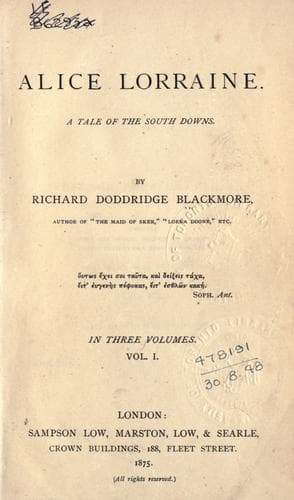
Alice Lorraine: A Tale of the South DownsBlackmore, R. D. (Richard Doddridge)
General
Alice Lorraine: A Tale of the South Downs
Blackmore, R. D. (Richard Doddridge)
Peninsular War, 1807-1814 -- Fiction; South Downs (England) -- Fiction
“Now I beg you to attend--you must try to attend,” continued Lady
Valeria: “rouse yourself up, if you please, dear Roland. This is
not a question of astrologers, or any queer thing of that sort, but
a common-sense matter, and, I might say, a difficult point of law,
perhaps.”
“That being so,” Sir Roland answered, with a smile of bright relief,
“our course becomes very simple. We have nothing that we need trouble
ourselves to be puzzled with uncomfortably. Messrs. Crookson, Hack, and
Clinker--they know how to keep in arrear, and to charge.”
“It is your own fault, my dear Roland, if they overcharge you.
Everybody will do so, when they know that you mean to put up with it.
Your dear father was under my guidance much more than you have ever
been, and he never let people overcharge him--more than he could help,
I mean.”
“I quite perceive the distinction, mother. You have put it very
clearly. But how does that bear upon the matter you have now to speak
of?”
“In a great many ways. This account of Hilary’s desperate behaviour, as
I must call it upon sound reflection, leads me to consider the great
probability of something happening to him. There are many battles yet
to be fought, and some of them may be worse than this. You remember
what Mr. Malahide said when your dear father would insist upon that
resettlement of the entire property in the year 1799.”
Sir Roland knew quite well that it was not his dear father at all, but
his mother, who had insisted upon that very stringent and ill-advised
proceeding, in which he himself had joined reluctantly, and only by
dint of her persistence. However, he did not remind her of this.
“To be sure,” he replied, “I remember it clearly; and I have his
very words somewhere. He declined to draw it in accordance with the
instructions of our solicitors, until his own opinion upon it had been
laid before the family--a most unusual course, he said, for counsel in
chambers to adopt, but having some knowledge of the parties concerned,
he hoped they would pardon his interference. And then his words were to
this effect--‘The operation of such a settlement may be most injurious.
The parties will be tying their own hands most completely, without--as
far as I can perceive--any adequate reason for doing so. Supposing,
for instance, there should be occasion for raising money upon these
estates during the joint lives of the grandson and granddaughter, and
before the granddaughter is of age, there will be no means of doing
it. The limitation to her, which is a most unusual one in such cases,
will preclude the possibility of representing the fee-simple. The young
lady is now just five years old, and if this extraordinary settlement
is made, no marketable title can be deduced for the next sixteen
years, except, of course, in the case of her decease.’ And many other
objections he made, all of which, however, were overruled; and after
that protest, he prepared the settlement.”
Public-domain text, read in full here on John Shaqi.
Reviews
Reviews
No reviews yet
Be the first to share your thoughts on this work.
Elsewhere in the archive
Join the Discussion
Join the discussion
Sign in to leave a comment or review.
Sign InorCreate an account