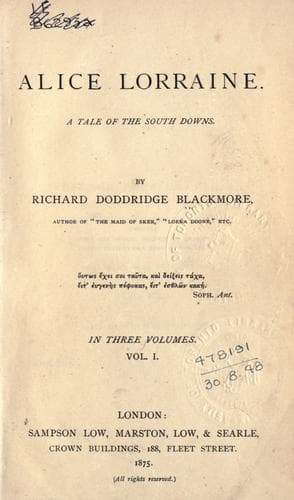
Alice Lorraine: A Tale of the South DownsBlackmore, R. D. (Richard Doddridge)
General
Alice Lorraine: A Tale of the South Downs
Blackmore, R. D. (Richard Doddridge)
Peninsular War, 1807-1814 -- Fiction; South Downs (England) -- Fiction
Pessimists who love to dwell on the darker side of human nature,
and find (or at any rate colour) that perpetually changing object
to the tone of their own dull thoughts, making our whole world no
better than the chameleon of themselves; who trace every act and word
and thought, either to very mean selfishness, or exceedingly grand
destiny--according to their own pet theory,--let those gloomy spirits
migrate in as cheerful a manner as they can manage to the back side
of the moon, the side that neither shines on earth, nor gathers any
earthshine. But even if they will not thus oblige inferior mortals, let
them not come near a scene where true love dwells, and simple faith,
and pleasant hours are spent in helping nature to be kind to us.
Where the rich recesses of the bosomed earth brim over with variety;
where every step of man discloses some new goodness over him; and
every hour of the day shows different veins of happiness; the light in
sloping glances looking richer as the sun goes down, and showing with a
deeper love its own good works and parentage; the children of the light
presenting all their varied joy to it; some revolving, many bending,
all with one accord inclining softly, sweetly, and thankfully,--can any
man, even of a churlish nature, wander about at a time like this, with
the power of the sunset over him, and walk down the alleys of trees,
and spend a leisure hour among them, without admitting into his heart a
calm unconscious kindliness?
If any man could be so ungrateful to the Giver of all good things,
he was not to be found in the land of Kent, but must be sought in
some northern county where they grow sour gooseberries. Master Martin
Lovejoy had, in the month of October, 1812, as fine a crop of pears as
ever made a fountain of a tree.
For the growers did not understand the pruning of trees as we do now.
They were a benighted lot altogether, proceeding only by rule of thumb
and the practice of their grandfathers, never lopping the roots of a
tree, nor summer pinching, nor wiring it, nor dislocating its joints;
and yet they grew as good fruit as we do! They had no right to do so;
but the thing is beyond denial. Therefore one might see a pear-tree
rising in its natural form, tall and straight and goodly, hanging
its taper branches like a chandelier with lustrous weight, tier upon
tier, the rich fruit glistening with the ruddy sun-streaks, or with
russet veinage mellowing. Hard thereby the Golden Noble, globular and
stainless, or the conical King Pippin, pencilled on its orange fulness
with a crimson glow, or the great bulk of Dutch Codlin, oblong, ribbed,
and over-bearing. Here was the place and time for a man to sit in the
midst of his garden, and feel that the year was not gone in vain, nor
his date of life lessened fruitlessly, and looking round with right
good will, thank the Lord, and remember his father.
Public-domain text, read in full here on John Shaqi.
Reviews
Reviews
No reviews yet
Be the first to share your thoughts on this work.
Elsewhere in the archive
Join the Discussion
Join the discussion
Sign in to leave a comment or review.
Sign InorCreate an account