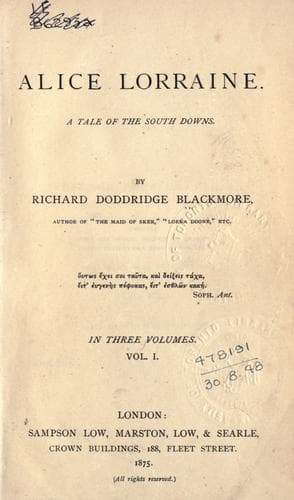
Alice Lorraine: A Tale of the South DownsBlackmore, R. D. (Richard Doddridge)
General
Alice Lorraine: A Tale of the South Downs
Blackmore, R. D. (Richard Doddridge)
Peninsular War, 1807-1814 -- Fiction; South Downs (England) -- Fiction
In such goodly mood and tenor Master Martin Lovejoy sat, early of an
October afternoon, to smoke his pipe and enjoy himself. He had finished
his dinner--a plain but good one; his teeth were sound, and digestion
stanch; he paid his tithes and went to church; he had not an enemy in
the world, to the utmost of his knowledge; and his name was good for a
thousand pounds from Canterbury to Reigate. His wheat had been fine,
and his hops pretty good, his barley by no means below the mark, the
cherry and strawberry season fair, and his apples and pears as you
see them. Such a man would be guilty of a great mistake if he kept on
the tramp perpetually. Fortune encouraged him to sit down, and set an
arm-chair and a cushion for him, and mixed him a glass of Schiedam and
water, with a slice of lemon, and gave him a wife to ask how his feet
were, as well as a daughter to see to his slippers.
“Now you don’t get on at all,” he said, as he mixed Mrs Lovejoy the
least little drop, because of the wind going round to the north; “you
are so abstemious, my dear soul; by-and-by you will pay out for it.”
“I must be a disciplinarian, Martin,” Mrs. Lovejoy replied, with a sad
sweet smile. “How ever the ladies can manage to take beer, wine, gin,
bitters, and brandy, in the way they do, all of an afternoon, is beyond
my comprehension.”
“They get used to it,” answered the Grower, calmly; “and their
constitution requires it. At the same time I am not saying, mind you,
that some of them may not overdo it. Moderation is the golden rule; but
you carry it too far, my dear.”
“Better too little than too much,” said Mrs. Lovejoy sententiously.
“Whatever I take, I like just to know that there is something in it,
and no more. No, Martin, no--if you please, not more than the thickness
of my thumb-nail. Well, now for what we were talking about. We can
never go on like this, you know.”
“Wife, I will tell you what it is”--here Martin Lovejoy tried to look
both melancholy and stern, but failed; “we do not use our duties right;
we do not work up in the position to which it has pleased God to call
us. We don’t make our children see that they are--bless my heart, what
is the word?”
“‘Obligated’ is the word you mean. ‘Obligated’ they all of them are.”
“No, no; ‘bounden’ is the word I mean; ‘bounden’ says the Catechism.
They are bounden to obey, whether they like it or no, and that is the
word’s expression. Now is there one of them as does it?”
“I can’t say there is,” his wife replied, after thinking of all three
of them. “Martin, no; they do their best, but you can’t have them quite
tied hand and foot. And I doubt whether we should love them better, if
we had them always to order.”
“Likely not. I cannot tell. They have given me no chance of trying.
They do what seems best in their own eyes, and the fault of it lies
with you, mother.”
Public-domain text, read in full here on John Shaqi.
Reviews
Reviews
No reviews yet
Be the first to share your thoughts on this work.
Elsewhere in the archive
Join the Discussion
Join the discussion
Sign in to leave a comment or review.
Sign InorCreate an account