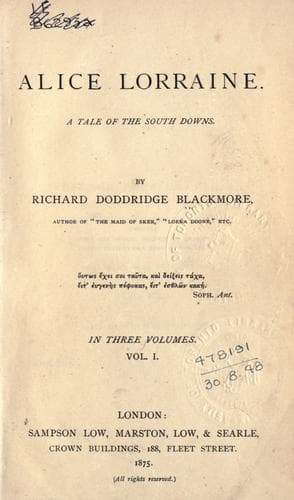
Alice Lorraine: A Tale of the South DownsBlackmore, R. D. (Richard Doddridge)
General
Alice Lorraine: A Tale of the South Downs
Blackmore, R. D. (Richard Doddridge)
Peninsular War, 1807-1814 -- Fiction; South Downs (England) -- Fiction
“Do they ever do anything wrong, Martin Lovejoy? Do they ever disgrace
you anywhere? Do they ever go about and borrow money, or trade on their
name, or anything? Surely you want to provoke me, Martin, when you
begin to revile my children.”
“Well,” said the Grower, blowing smoke, in the manner of a matrimonial
man, “let us go to something else. Here is this affair of Mabel’s now.
How do you mean to settle it?”
“I think you should rather tell me, Martin, how you mean to settle
it. She might have been settled long ago, in a good position and
comfortable, if my advice had been heeded. But you are the most
obstinate man in the world.”
“Well, well, my dear, I don’t think that you should be hard upon any
one in that respect. You have set your heart upon one thing, and I upon
another; and we have to deal with some one perhaps more obstinate than
both of us. She takes after her good mother there.”
“After her father, more likely, Martin. But she has given her promise,
and she will keep it, and the time is very nearly up, you know.”
“The battle of Trafalgar, yes. The 21st of October, seven years ago, as
I am a man! Lord bless me, it seems but yesterday! How all the country
up and wept, and how it sent our boy to sea! There never can be such a
thing again; and no one would look at a drumhead savoy!”
“Plague upon the market, Martin! I do believe you think much more
of your growings than your gainings. But she fixed the day herself,
because it was a battle; didn’t she?”
“Yes, wife, yes. But after all, I see not so much to come of it.
Supposing she gets no letter by to-morrow-night, what comes of it?”
“Why, a very great deal. You men never know. She puts all her foolish
ideas aside, and she does her best to be sensible.”
“By the spread of my measure, oh deary me! I thought she was bound to
much more than that. She gives up him, at any rate.”
“Yes, poor dear, she gives him up, and a precious cry she will make
of it. Why, Martin, when you and I were young we carried on so
differently.”
“What use to talk about that?” said the Grower: “they all must have
their romances now. Like tapping a cask of beer, it is. You must let
them spit out at the top a little.”
“All that, of course, needs no discussion. I do not remember that, in
our love-time, you expected to see me ‘spit out at the top!’ You grow
so coarse in your ideas, Martin; the more you go growing, the coarser
you get.”
“Now, is there nothing to be said but that? She gives him up, and she
tries to be sensible. The malting season is on, and how can Elias come
and do anything?”
“Martin, may I say one word? You keep so perpetually talking, that I
scarcely have a chance to breathe. We do not want that low Jenkins
here. How many quarters he soaks in a week is nothing, and cannot be
anything to me. A tanner is more to my taste a great deal, if one must
come down to the dressers. And there one might get some good ox-tails.
I believe that you want to sell your daughter to get your malt for
nothing.”
Public-domain text, read in full here on John Shaqi.
Reviews
Reviews
No reviews yet
Be the first to share your thoughts on this work.
Elsewhere in the archive
Join the Discussion
Join the discussion
Sign in to leave a comment or review.
Sign InorCreate an account