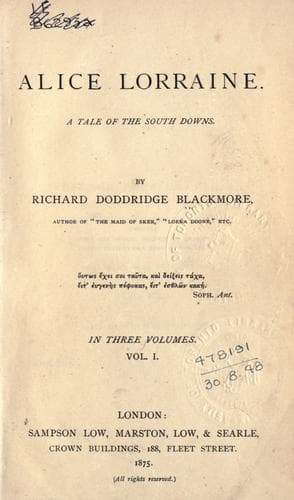
Alice Lorraine: A Tale of the South DownsBlackmore, R. D. (Richard Doddridge)
General
Alice Lorraine: A Tale of the South Downs
Blackmore, R. D. (Richard Doddridge)
Peninsular War, 1807-1814 -- Fiction; South Downs (England) -- Fiction
And he needed her now in matters even more stirring than the hottest
love-affairs. For though he had no chance of coming to the front in
any of the desperate assaults on the castle of Burgos, being far away
then with despatches, he was back with his chief when the retreat
began; a retreat which must have become a rout under any but the finest
management. For the British army was at its worst towards the month of
November, 1812. Partly from intercourse with _partidas_, partly perhaps
from the joys of Madrid, but mainly no doubt from want of cash, the
Britons were not as they had been. Even the officers dared to be most
thoroughly disobedient, and to follow the route which they thought
best, instead of that laid down for them. But Wellington put up with
insolent ignorance, as a weaker man could not have deigned to do: he
had to endure it from those above him; and he knew how to bear it with
all around him; and yet to be the master. His manifold dealings with
everybody and everything at this time (with nobody caring to understand
him, and his own people set against him; with the whole world making
little of him, because he hated flash-work; and perhaps his own mind
in some doubt of its powers, because they were not recognised)--these,
and the wearisome uphill struggle to be honest without any money, were
beginning to streak with grey the hair that had all the hard brain
under it.
Here again was a chance for Hilary; and without thinking, he worked it
well. In his quick, and perhaps too sudden, way of taking impression of
every one, he had stamped on his mind the abiding image of his great
commander. The General knew this (as all men feel the impression they
are making, as sharply almost as a butter-stamp), and of course he felt
goodwill towards the youth who so looked up to him. It was quite a new
thing for this great Captain, after all his years of conquest, to be
accounted of any value; because he was not a Frenchman.
Being, however, of rigid justice, although he was no Frenchman,
Lord Wellington did not lift Captain Lorraine over the heads of his
compeers. He only marked him (in his own clear and most tenacious mind)
as one who might be trusted for a dashing job, and deserved to have the
chance of it.
And so they went into winter quarters on the Douro and Aguada, after
a great deal of fighting, far in the rear of their storms and sieges
and their many victories; because the British Government paid whole
millions right and left to rogues, and left its own army to live
without money, and to be hanged if it stole an onion. And the only
satisfaction our men had--and even in that they were generous--was to
hear of the Frenchmen in Russia freezing, as fast as could well be
expected.
Public-domain text, read in full here on John Shaqi.
Reviews
Reviews
No reviews yet
Be the first to share your thoughts on this work.
Elsewhere in the archive
Join the Discussion
Join the discussion
Sign in to leave a comment or review.
Sign InorCreate an account