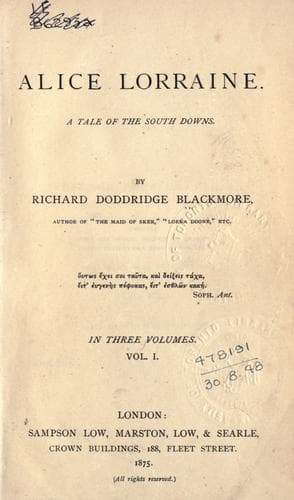
Alice Lorraine: A Tale of the South DownsBlackmore, R. D. (Richard Doddridge)
General
Alice Lorraine: A Tale of the South Downs
Blackmore, R. D. (Richard Doddridge)
Peninsular War, 1807-1814 -- Fiction; South Downs (England) -- Fiction
Now, while this return to the frontier, and ebb of success created
disgust in England and depression among our soldiers, they also bore
most disastrously on the fortunes of a certain gallant and very zealous
Staff officer. For they brought him again into those soft meshes,
whence he had wellnigh made good his escape without any serious damage;
but now there was no such deliverance for him. And this was a very hard
case, and he really did deserve some pity now; for he did not return
of his own accord, and fall at the feet of the charmer; but in the
strictest course of duty became an unwilling victim. And it happened
altogether in this wise.
In the month of May, 1813, when the British commander had all things
ready for that glorious campaign which drove the French over the
Pyrenees; and when the British army, freshened, strengthened, and
sternly redisciplined, was eager to bound forward--a sudden and sad
check arose. By no means, however, a new form of hindrance, but one
only too familiar at all times and in all countries--the sinews of
war were not forthcoming. The military chest was empty. The pay of
the British troops was far in arrear, and so was their bounty-money;
but that they were pretty well used to by this time, and grumble as
they might, they were ready to march. Not so, however, the Portuguese,
who were now an important element; and even the Spanish regulars in
Andalusia would do nothing, until they had handled dollars.
This need of money had been well foreseen by the ubiquitous mind of
Wellington; but what he had not allowed for, and what no one else
would have taken into thought, so soon after Nelson’s time, was the
sluggishness of the British navy. Whether it were the fault of our
Government, or of our Admiral on the station, certain it is that the
mouth of the Tagus (which was the mouth of the whole British army)
was stopped for days, and even weeks together, by a few American
privateers. And ships containing supplies for our army (whether of
food, or clothing, or the even more needful British gold), if they
escaped at all, could do it only by running for the dangerous bar of
the Douro, or for Cadiz.
In this state of matters, the “Generalissimo” sent for Captain Lorraine
one day, and despatched him on special duty.
“You know Count Zamora,” said Lord Wellington, in his clear voice of
precision; “and his castle in the Sierra Morena.”
Hilary bowed, without a word, knowing well what his Chief was pleased
with.
Public-domain text, read in full here on John Shaqi.
Reviews
Reviews
No reviews yet
Be the first to share your thoughts on this work.
Elsewhere in the archive
Join the Discussion
Join the discussion
Sign in to leave a comment or review.
Sign InorCreate an account