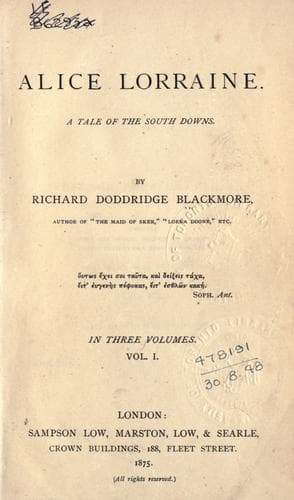
Alice Lorraine: A Tale of the South DownsBlackmore, R. D. (Richard Doddridge)
General
Alice Lorraine: A Tale of the South Downs
Blackmore, R. D. (Richard Doddridge)
Peninsular War, 1807-1814 -- Fiction; South Downs (England) -- Fiction
“Well, she come on the bridge for all the world like that. Us have seen
it fifty times. And she had a white handkercher on her head, or an
Ishmaelitish mantle; and she were looking out for some young chap. And
our young cap’en come after her. And who do you think she were? Why,
one of the daughters of the old Don up yonner!”
“Good heart alaive, now, Sergeant Bones, I can’t a’most belave it!”
“Nickles, I tell you what was told me--word for word; and I say no
more. But knowing what the ways of the women is, as us dragoons is so
forced to do, even after a marriage and family----”
“Ah, sergeant, sergeant! we tries in vain to keep inside the strick
line of dooty. I does whatever a man can do; and my father were a
butcher.”
“Corporal, it is one of the trials which the Lord has ordered. They do
look up at one so, and they puts the middle of their lips up, and then
with their bodies they turns away, as if there was nothing to look at.
But, Nickles, they gives you no sort of a chance to come to the bottom
of them. And this is what young cap’en will find out. The good females
always is found out at last; the same as my poor wife was. But here
us are. We have relaxed the bonds of discipline with conversation.
Corporal, eyes right, and wait orders!”
While these two trusty and veteran fellows had been discussing a
subject far too deep for a whole brigade of them, and still were full
of tender recollections (dashed with good escape), poor Hilary had
been vainly spurring, here and there, and all about, himself not come
to his clear mind yet, only hoping to know where the money was gone.
Hope, however, upon that point was disappointed, as usual. The track
of the heavy carts was clear in the gravel of the river, and up the
rocky bank, and on the old Roman road towards Merida. And then, at
the distance of about a furlong from the Zujar, the rut of the wooden
wheels turned sharply into an elbow of a mountain-road. Here, on the
hump of a difficult rise, were marks, as if many kicks, and pricks, and
even stabs, had been ministered to good mules labouring heavily. There
was blood on the road, and the blue shine of friction, where hard rock
encountered hard iron, and the scraping of holes in gravelly spots,
and the nicks of big stones laid behind wheels to ease the tugging,
and afford the short relief of panting. These traces were plain, and
becoming plainer as the road grew worse, for nearly a mile of the
mountain-side, and then the track turned suddenly into a thicket of
dark ilex, where, out of British sight and ken, the spoil had been
divided.
Public-domain text, read in full here on John Shaqi.
Reviews
Reviews
No reviews yet
Be the first to share your thoughts on this work.
Elsewhere in the archive
Join the Discussion
Join the discussion
Sign in to leave a comment or review.
Sign InorCreate an account