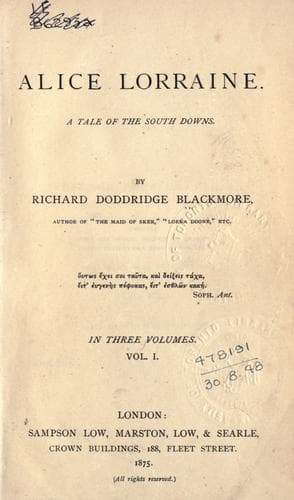
Alice Lorraine: A Tale of the South DownsBlackmore, R. D. (Richard Doddridge)
General
Alice Lorraine: A Tale of the South Downs
Blackmore, R. D. (Richard Doddridge)
Peninsular War, 1807-1814 -- Fiction; South Downs (England) -- Fiction
This grandly philosophical, and most truly Spanish, view of the
case destroyed poor Hilary’s last fond hope of any sense of a debt
of honour, on the part of the Montalvans. If the money lost had
been Hilary’s own, the Count of Zamora (all compact of chivalry and
rectitude) might have discovered that he was bound to redeem his
daughter’s robbery. But as it stood, there was no such chance. Private
honour is a mountain rill that does not always lead to any lake of
public honesty. All Spaniards would bow to the will of the Lord, that
British guineas should slip into Spanish hands so providentially.
“We do not take things just so,” said young Lorraine quite sadly. “I
must go home and restore the money. Donna Camilla, I must say farewell.”
“You will come again when you are restored? When you have proved that
you did not take the money for yourself, Senhor, you will remember your
Spanish friends?”
“I never shall forget my Spanish friends. To you I owe my life, and
hold it (as long as I hold it) at your command.”
“It is generously said, Senhor. Generosity always makes me weep. And
so, farewell.”
CHAPTER LIV.
GOING UP THE TREE.
In all the British army--then a walking wood of British oak, without a
yard of sapling--there was no bit of better stuff than the five feet
and a quarter (allowing for his good game leg) of Major, by this time
Colonel Clumps. This officer knew what he had to do, and he made a
point of doing it. Being short of imagination, he despised that foolish
gift, and marvelled over and over again at others for laughing so at
nothing. That whimsical tickling of the veins of thought, which some
people give so and some receive (with equal delight on either side),
humour, or wit, or whatever it is, to Colonel Clumps was a vicious
thing. Everything must be either true or false. If it were true, who
could laugh at the truth? If it were false, who should laugh at a
falsehood?
Many a good man has reasoned thus, reducing laughter under law, and
himself thenceforth abandoned by that lawless element. Colonel Clumps
had always taken solid views of everything, and the longer he lived in
the world the less he felt inclined to laugh at it. But, that laughter
might not be robbed of all its dues and royalties, just nature had
provided that, as the Colonel would not laugh at the world, the world
should laugh at the Colonel. He had been the subject of more bad jokes,
one-sided pleasantries, and heartless hoaxes, than any other man in
the army; with the usual result that now he scarcely ever believed the
truth, while he still retained, for the pleasure of his friends, a
tempting stock of his native confidence in error. So it came to pass
that when Colonel Clumps (after the battle of Vittoria, in which he had
shown conspicuous valour) was told of poor Hilary’s sad disgrace, he
was a great deal too clever and astute to believe a single word of it.
Public-domain text, read in full here on John Shaqi.
Reviews
Reviews
No reviews yet
Be the first to share your thoughts on this work.
Elsewhere in the archive
Join the Discussion
Join the discussion
Sign in to leave a comment or review.
Sign InorCreate an account