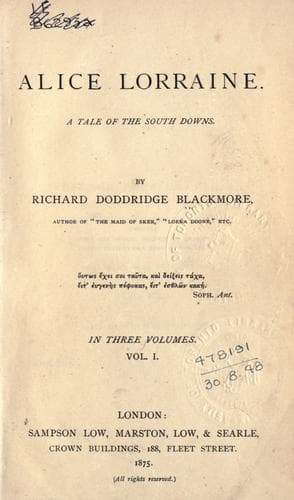
Alice Lorraine: A Tale of the South DownsBlackmore, R. D. (Richard Doddridge)
General
Alice Lorraine: A Tale of the South Downs
Blackmore, R. D. (Richard Doddridge)
Peninsular War, 1807-1814 -- Fiction; South Downs (England) -- Fiction
“It is ludicrous, perfectly ludicrous!” he said, that being the
strongest adjective he knew to express pure impossibility. “A gallant
young fellow to be cashiered without even a court-martial! How dare you
tell me such a thing, sir? I am not a man to be rough-ridden. Nobody
ever has imposed on me. And the boy is almost a sort of cousin of my
own. The first family in the kingdom, sir.”
The colonel flew into so great a rage, twisting his white hair, and
stamping his lame heel, that the officer who had brought the news,
being one of his own subalterns, wisely retired into doubts about it,
and hinted that nobody knew the reason, and therefore that it could not
be true.
“If I mention that absurd report about young Lorraine,” thought
Colonel Clumps, when writing to Lady de Lampnor, “I may do harm, and
I can do no good, but only get myself laughed at as the victim of a
stupid hoax. So I will say no more about him, except that I have not
seen him lately, being so far from head-quarters, and knowing how Old
Beaky is driving the staff about.” And before the brave Colonel found
opportunity of taking the pen in hand again, he was heavily wounded in
a skirmish with the French rear-guard, and ordered home, as hereafter
will appear.
It also happened that Mr. Capper’s friends, those two officers who had
earned so little of Mabel’s gratitude by news of Hilary, were harassed
and knocked about too much to find any time for writing letters. And
as the _Gazette_ in those days neglected the smaller concerns of the
army, and became so hurried by the march of events, and the rapid
sequence of battles, that the doings of junior officers slipped through
its fingers until long afterwards, the result was that neither Coombe
Lorraine nor Old Applewood farm received for months any news of the
young staff officer. Neither did he yet present himself at either of
those homesteads. For, as the ancient saying runs, misfortunes never
come alone. The ship in which Hilary sailed for England from the port
of Cadiz--for he found no transport at Malaga--_The Flower of Kent_, as
she was called, which appeared to him an excellent omen, was nipped in
the bud of her homeward voyage. She met with a nasty French privateer
to the southward of Cape Finisterre. In vain she crowded sail, and
tried every known resource of seamanship; the Frenchman had the heels
of her, and laid her on board at sundown. Lorraine, and two or three
old soldiers, battered and going to hospital, had no idea of striking,
except in the British way of doing it. But the master and mate knew
better, and stopped the hopeless conflict. So the Frenchman sacked
and scuttled the ship in the most scientific manner, and, wanting no
prisoners, landed the crew on a desolate strand of Gallicia, without
any money to save them.
Public-domain text, read in full here on John Shaqi.
Reviews
Reviews
No reviews yet
Be the first to share your thoughts on this work.
Elsewhere in the archive
Join the Discussion
Join the discussion
Sign in to leave a comment or review.
Sign InorCreate an account