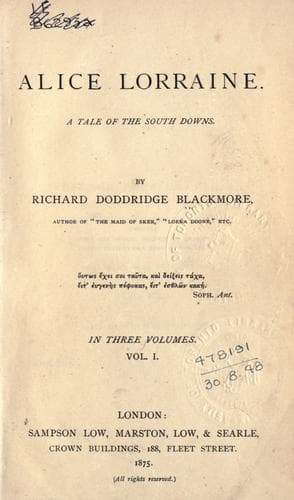
Alice Lorraine: A Tale of the South DownsBlackmore, R. D. (Richard Doddridge)
General
Alice Lorraine: A Tale of the South Downs
Blackmore, R. D. (Richard Doddridge)
Peninsular War, 1807-1814 -- Fiction; South Downs (England) -- Fiction
“I will go to the rectory first,” he thought; “Uncle Struan is violent,
but he is warm. And though he has three children of his own, he loves
me much more than my father does.”
With this resolution, he turned on the right down a lane that came
out by the rectory. The lane broke out suddenly into black water; and
a tall robust man stood in the twilight, with a heavy spade over his
shoulder. And Hilary Lorraine went up to him.
“No, no, my man; not a penny to spare!” said the Rector in
anticipation; “we have a great deal too much to do with our own poor,
and with this new trouble especially. The times are hard--yes, they
always are; I never knew them otherwise. But an honest man always can
get good work. Or go and fight for your country, like a man. But we
can’t have any vagrants in my parish.”
“I have fought for my country like a man, Uncle Struan; and this is all
that has come of it.”
“Good God, Hilary!” cried the Rector; and for a long time he found
nothing better to say.
“Yes, Uncle Struan, don’t you understand? Every one must have his ups
and downs. I am having a long spell of downs just now.”
“My dear boy, my dear boy! Whatever have you done?”
“Do you mean to throw me over, Uncle Struan, as the rest of the world
has beautifully done! Everything seems to be upset. What is the meaning
of this broad, black stream?”
“Come into my study, and tell me all. I can let you in without sight of
your aunt. The shock would be too great for her.”
Hilary followed, without a word. Mr. Hales led him in at the window,
and warmed him, and covered him with his own dressing-gown, and watched
him slowly recovering.
“Never mind the tar on your hands; it is an honest smell,” he said; “my
poor boy, my poor boy, what you must have been through!”
“Whatever has happened to me,” answered Hilary, spreading his thin
hands to the fire, “has been all of my own doing, Uncle Struan.”
“You shall have a cordial, and you shall tell me all. There, I have
bolted the door. I am your parson as well as your uncle. All you say
will be sacred with me. And I am sure you have done no great harm after
all. We shall see what your dear aunt thinks of it.”
Then Hilary, sipping a little rum-and-water, wandered through his
story; not telling it brightly, as once he might have done, but hiding
nothing consciously.
“Do you mean to tell me there is nothing worse than that?” asked the
Rector, with a sigh of great relief.
“There is nothing worse, uncle. How could it be worse?”
“And they turned you out of the army for that! How thankful I am for
belonging to the Church! You are simply a martyred hero.”
“Yes, they turned me out of the army for that. How could they help it?”
Reasoning thus, he met his uncle’s look of pity, and it was too much
for him. He did what many a far greater man, and braver hero has done,
and will do, when the soul is moving. He burst into a hot flood of
tears.
CHAPTER LVI.
GOING DOWN THE HILL.
Public-domain text, read in full here on John Shaqi.
Reviews
Reviews
No reviews yet
Be the first to share your thoughts on this work.
Elsewhere in the archive
Join the Discussion
Join the discussion
Sign in to leave a comment or review.
Sign InorCreate an account